

Quick answer: Tree removal costs about $850 on average in 2026, with most homeowners paying $385 to $1,070. Small trees under 30 feet run roughly $285 to $435, while trees over 80 feet can cost $1,160 to $2,000 or more. Tree trimming averages about $420 per tree, typically $255 to $655.
Use the calculator below to estimate your job. It accounts for height, species, how close the tree is to your house or power lines, and add-ons like stump grinding and log hauling.
Tree Trimming & Removal Cost Calculator (2026)
Pick the job, tree size and conditions to see what local tree services typically charge.
Based on 2026 national averages: removal runs about $9.50–$14.50 per foot of height, and trimming about $255–$655 per tree. Never climb or cut near power lines yourself — call the utility.
Tree Removal Cost by Height (2026)
Height is the biggest price driver because taller trees take longer to climb, rig and lower in sections. Most companies work out to roughly $9.50 to $14.50 per foot, according to Lawn Love’s 2026 tree removal pricing.
| Tree height | Typical removal cost | Common examples |
|---|---|---|
| Under 30 ft | $285–$435 | Dogwood, crabapple, young maple, fruit trees |
| 30–60 ft | $435–$870 | Mature maple, birch, ash, most backyard trees |
| 60–80 ft | $870–$1,160 | Mature oak, pine, tulip poplar |
| Over 80 ft | $1,160–$2,000+ | Large oaks, tall pines, sycamores |
Tree Removal Cost by Type of Tree
Species matters because of wood density, branch spread and how the tree typically grows. Wide-crowned oaks and tall, sappy conifers take more rigging; palms are usually the cheapest to drop.
| Tree type | Typical removal cost |
|---|---|
| Palm | $310–$475 |
| Oak | $380–$1,160 |
| Ash | $475–$1,160 |
| Pine | $475–$1,450 |
| Maple | $570–$1,305 |
| Cedar | $570–$1,740 |
How Much Does Tree Trimming Cost?
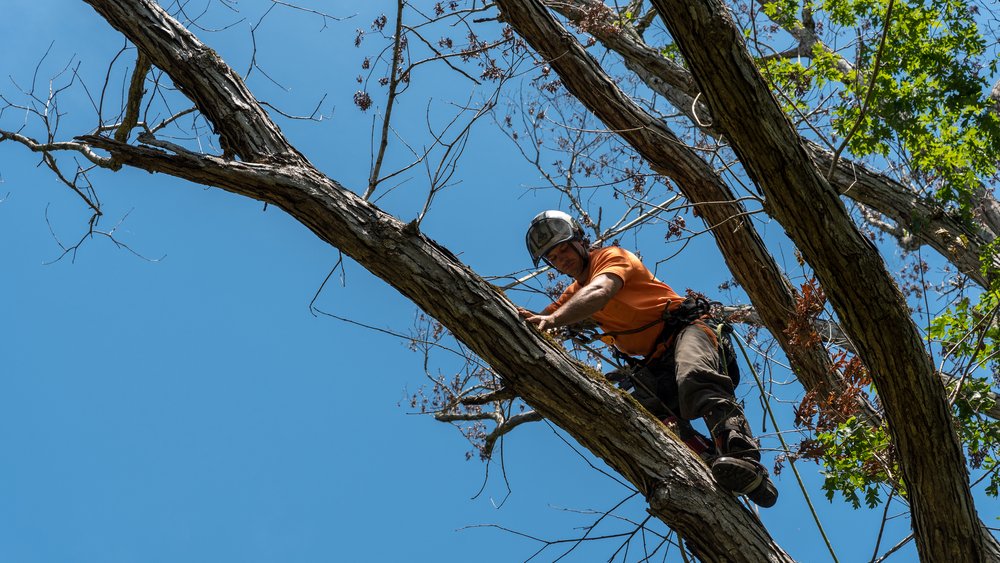
Routine trimming averages about $420 per tree and usually lands between $255 and $655. Small ornamentals can be $150 or less, while pruning a 60-plus foot oak can run $1,000 or more.
| Tree height | Typical trimming cost |
|---|---|
| Under 30 ft | $150–$400 |
| 30–60 ft | $300–$700 |
| 60–80 ft | $600–$1,100 |
| Over 80 ft | $900–$1,800 |
Most healthy trees only need pruning every 3 to 5 years. Fruit trees and fast-growing species benefit from yearly attention. The best time to prune most deciduous trees is late winter, while they’re dormant — cuts heal faster and it’s easier to see the branch structure.
What Else Affects the Price
Location and risk
A tree in an open yard can often be felled in one piece. A tree hanging over a roof, fence, pool or power lines has to be taken down in small sections with ropes, which can add 25% to 50% to the bill. If a crane or bucket truck is needed, expect another $500 to $1,500.
Tree condition
Dead or diseased trees are brittle and unpredictable, so crews work more slowly. Storm-damaged trees and emergency calls command premium pricing — commonly $450 to $3,000 for the job, or $150 to $250 per hour.
Common add-ons
| Add-on | Typical cost |
|---|---|
| Stump grinding | $150–$350 per stump |
| Log and brush haul-away | $100–$200 per job |
| Log splitting for firewood | $75–$100 per tree |
| Wood chipping | $75–$125 per hour |
| Crane or bucket truck | $500–$1,500 |
| City removal permit | $60–$150 (some cities more) |
| Arborist risk assessment | $100–$250 |
Ask whether stump grinding is included — many removal quotes stop at ground level. Our stump grinding cost calculator breaks that job down by diameter.
How to Get an Accurate Quote
- Get three written estimates. Prices for the same tree can vary by hundreds of dollars.
- Make sure each quote spells out cleanup, haul-away, stump grinding, and who handles the permit.
- Ask for proof of insurance — general liability and workers’ compensation — sent directly from the insurer. Without it, you could be liable if a worker is hurt or a limb hits your neighbor’s house.
- Look for ISA-certified arborists for pruning and any tree you’re hoping to save.
- Be wary of door-knockers after storms who ask for full payment up front.
How to Save on Tree Work
- Book in late winter. January through March is the slow season for most tree companies, and frozen ground protects your lawn from equipment.
- Do several trees at once. Crews often discount 10% to 15% when they’re already set up on your property.
- Keep the wood. Skipping haul-away saves $100 to $200, and the logs make good firewood once split and seasoned.
- Don’t wait. A dead tree gets more dangerous — and more expensive — to remove every year.
- Check your homeowners policy if a tree falls on a covered structure. Removal from the structure is often covered.
Trees and Robot Mowers
Low branches, surface roots and dense canopy are common trouble spots for robot mowers. Raising the canopy to about 6 to 8 feet keeps branches off the mower’s sensors and lets more light reach the grass, and thinning a dense crown can improve the satellite signal that RTK models rely on. If you’re planning tree work ahead of a robot mower install, our Robot Mower Finder can help you pick a model that handles your yard.
Tree Removal and Trimming Cost FAQ
How much does it cost to remove a large tree?
Removing a 60 to 80 foot tree typically costs $870 to $1,160, and trees over 80 feet often cost $1,160 to $2,000 or more. Trees near structures or power lines, or that need a crane, can exceed those ranges.
Is stump grinding included in tree removal?
Often not. Many companies cut the stump flush with the ground and charge separately to grind it, usually $150 to $350 per stump. Confirm before you sign.
Do I need a permit to remove a tree?
It depends on your city and HOA. Many municipalities require a permit for large trees, protected species, or trees in the public right-of-way. Permits typically cost $60 to $150, and fines for removing a protected tree without one can be steep.
Will homeowners insurance pay for tree removal?
Usually only when a tree falls on a covered structure such as your house, garage or fence. Most policies don’t pay to remove a healthy tree or one that falls in the yard without hitting anything.
How often should trees be trimmed?
Every 3 to 5 years for most mature shade trees, and every 1 to 3 years for young trees and fruit trees. Trim sooner if branches are touching the roof, overhanging the driveway, or showing dead wood.

2 thoughts on “Tree Trimming and Removal Cost Calculator (2026): Prices by Tree Size”