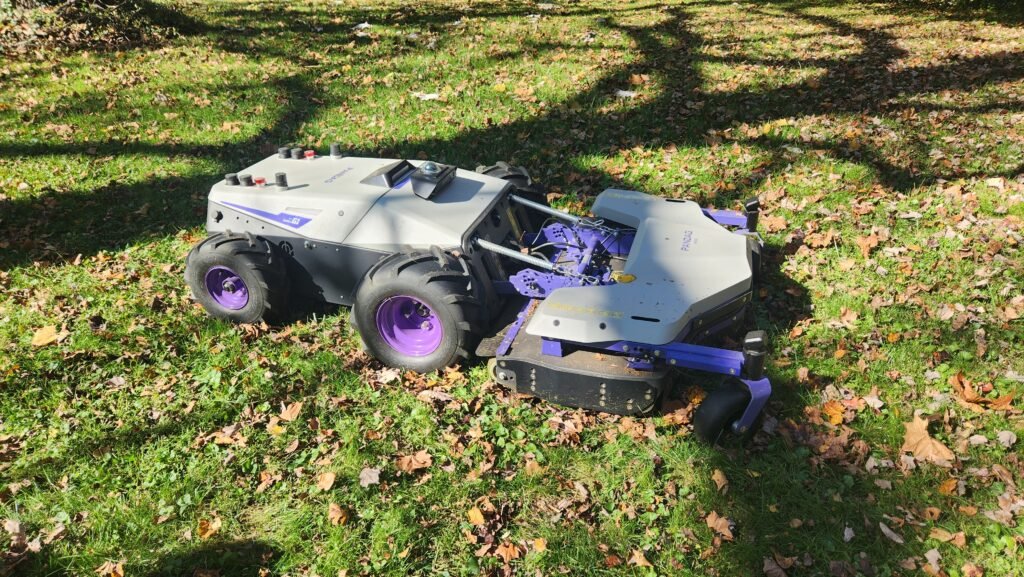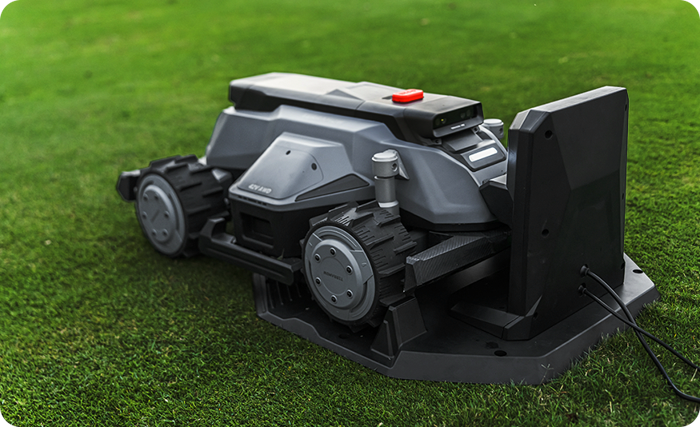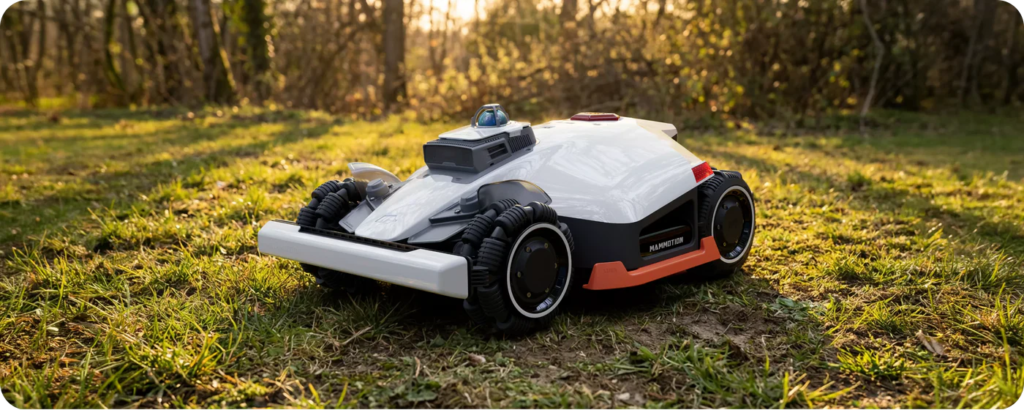

Mammotion built its name on wire-free residential robots like the LUBA series. The Mammotion Maston is the company’s first machine built for commercial turf: golf courses, sports fields, parks, campuses and large estates. It previewed at CES 2026, launched at IFA in September, and is now on pre-order through dealers in Europe, Australia and New Zealand.
The pitch is simple. Take the LiDAR, camera and RTK navigation that made Mammotion’s home mowers popular, scale it up to a 24- or 27-inch deck with all-wheel drive, and add the fleet software and quick-swap hardware that grounds crews need. Below is what the Maston offers, how its two versions differ, what it costs so far, and how it stacks up against the rest of the commercial field.
Note: this review is based on Mammotion’s published specifications, dealer listings and launch coverage. We haven’t run a Maston on our own test turf yet.
Mammotion Maston at a Glance
| Type | Commercial wire-free robotic mower, battery electric |
| Versions | Maston Rotary (rough and overgrown grass) and Maston Flail (fine turf) |
| Coverage | Flail: up to 40,000 m² (about 10 acres) per day. Rotary: up to 24,000 m² (about 6 acres) per day |
| Cutting width | Rotary: 24.4 in (62 cm). Flail: 26.8 in (68 cm) |
| Minimum cut height | Flail: 0.39 in (10 mm). Rotary: about 1 in (25 mm) |
| Cutting system | Three-disc triangular layout, up to 6,000 RPM (Rotary uses three 500 W motors) |
| Max slope | 70% (35°) |
| Drive | All-wheel drive, zero-turn front steering, independent suspension, Intelligent Hill Hold |
| Navigation | Tri-Fusion 2.0: 360° LiDAR, three AI cameras, NetRTK, four ultrasonic sensors; no perimeter wire |
| Power | Quick-swap battery, 500 W fast charging, multi-charger support |
| Fleet tools | Central fleet dashboard, remote diagnostics, OTA updates, up to 100 mowing zones |
| Price | No US price yet. New Zealand dealer pre-order: NZ$44,990 incl. GST |
| Availability | Pre-order in Europe, Australia and NZ; US demos by request |
Rotary vs. Flail: Which Maston Do You Need?
The biggest decision with the Maston is the cutter. Both versions share the same chassis, drive system and navigation, but they’re built for very different turf.
Maston Rotary
The Rotary is the workhorse. Three 500 W motors spin the blades up to 6,000 RPM across a 24.4-inch cut, and Mammotion rates it for up to about 6 acres a day. It’s built for thick, coarse and overgrown grass, which makes it the better pick for parks, estates, orchards, campus perimeters and naturalized areas. One New Zealand dealer notes it also needs less maintenance than the Flail, at the cost of a slightly less refined finish. The minimum cut is about 1 inch.
Maston Flail
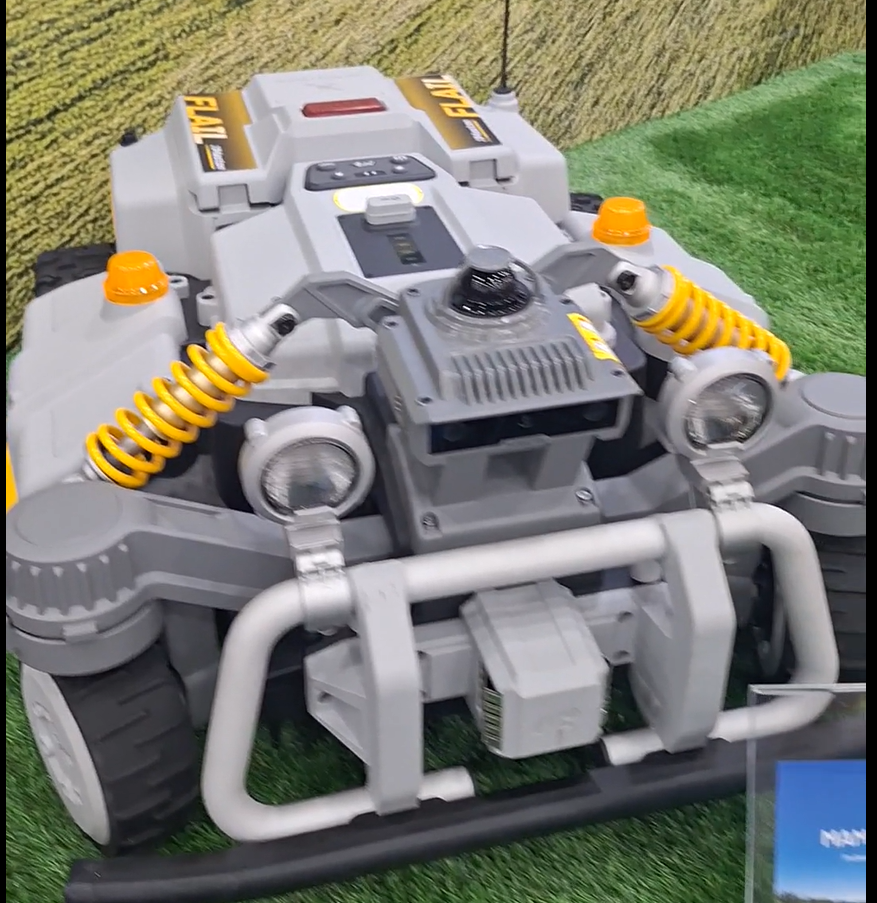
The Flail is the precision version. Its three overlapping discs sit on a floating 26.8-inch deck that follows uneven ground, and it cuts as low as 0.39 inches (10 mm). Dual-layer mulching blades keep clippings small and resist clogging in wet or dense grass. Mammotion rates it for up to about 10 acres a day. That combination of low cut and high output points it at golf fairways and surrounds, sports fields and premium hotel or resort grounds. The trade-off is upkeep: flail razors may need changing more often in demanding conditions.
Quick rule: if you maintain turf under 1 inch, or care most about finish, choose the Flail. If you’re mowing rough, tall or mixed grass and want lower maintenance, choose the Rotary.
What Makes the Maston Stand Out
A Cut Height Most Robots Can’t Reach
Most commercial robots bottom out around 0.6 to 0.9 inches, and many fixed-site units can’t go below an inch. The Maston Flail’s 0.39-inch minimum puts it in reach of fairways and elite sports turf, a job usually reserved for autonomous reel mowers like the Toro GeoLink or FireFly AMP-L100, or low-cut decks like the Husqvarna CEORA RZ 43L. Few battery robots of this size get that low.
LiDAR, Cameras and RTK Together
Mammotion’s Tri-Fusion 2.0 system combines 360° LiDAR, three AI cameras, NetRTK positioning and four ultrasonic sensors, all run by a 10 TOPS AI processor. Satellite-only robots tend to drift or stall under tree canopy and near buildings. Adding LiDAR and vision should help the Maston keep its position in those spots and spot obstacles such as people, benches and branches. Mammotion’s case study from Club de Golf Montanyà in Barcelona specifically mentions accurate positioning in wooded areas.
NetRTK also means there’s no reference station to install. An RTK antenna ships with the mower, and corrections come over the network. Like other network-RTK systems, that depends on reliable cellular coverage at every site.
Real Slope Capability
All-wheel drive, independent suspension and a 70% (35°) slope rating put the Maston well above most large-area robots, which are often rated for 20% to 45%. Zero-turn front steering limits scuffing on tight turns, and Intelligent Hill Hold keeps the machine from rolling back when it stops on a grade. That opens up golf banks, berms and detention-pond slopes that many robots can’t handle.
Built for Uptime
Commercial buyers care about downtime as much as cut quality. The Maston has a quick-swap battery, 500 W fast charging, and multi-charger intelligence that sends it to the nearest charger on large sites. Cutting discs, motors, batteries, control boards, wheels and sensors are modular, so technicians can swap parts in the field. Remote diagnostics and over-the-air updates round it out.
Fleet Management and Lawn Printing
A central dashboard coordinates multiple mowers, splits large sites into zones (up to 100) and shows performance and health data. Mammotion also advertises “3D lawn printing,” the ability to mow patterns and logos into turf, which is a nice extra for stadiums, resorts and branded campuses.
Early Results From Real Sites
Mammotion has published a handful of early deployments, all using the Maston Flail:
- TC 1899 Blau-Weiss, Berlin: about 5 acres of tennis, hockey and landscaped grounds. Mammotion says the club cut turf maintenance time and costs by an estimated 30% to 40%.
- Golf Zlati Grič, Slovenia: about 15 acres of golf turf among vineyards, where the AWD handled sloped terrain.
- Club de Golf Montanyà, Spain: slopes up to 60%, with low-noise operation and steady positioning in wooded areas at speeds up to about 2.2 mph.
- Botta Farms, Hungary: an apple orchard with tight rows and uneven ground.
These are manufacturer-reported results, so treat them as a starting point rather than independent proof. Still, they cover exactly the scenarios commercial buyers worry about: slopes, trees and tight spaces.
Where the Maston Fits Best
- Golf courses: the Flail for fairways, surrounds and roughs, especially hilly courses
- Sports fields and complexes: low cut, consistent finish and scheduled overnight mowing
- Parks, campuses and business parks: LiDAR and cameras help around trees, paths and people
- Estates, horse farms and vineyards: the Rotary for rougher grass across sloped, open acreage
It’s a weaker fit for landscape contractors who need to trailer one machine between many client properties every day. The Maston is designed to live on site and dock to charge. For that route-based work, look at autonomous mowers like the Kress Voyager or Exmark Turf Tracer. Our Commercial Robot Mower Finder sorts these machine types out for you.
Pros and Cons
What We Like
- 0.39-inch minimum cut on the Flail, rare for a battery robot this size
- Two cutter options on one platform for fine turf or rough grass
- 70% slope rating with AWD, suspension and hill hold
- LiDAR + vision + NetRTK should hold up better under trees than RTK-only robots
- No reference station or perimeter wire to install
- Uptime features: quick-swap battery, fast charging, modular parts, remote diagnostics
- Fleet dashboard and lawn printing for multi-mower sites
- Likely competitive pricing, based on overseas dealer listings
What to Ask About
- No US launch date or price. Mammotion’s US site only offers demo requests for now.
- Battery and runtime specs are thin. Mammotion hasn’t published runtime or charge time, and one regional announcement lists a battery of up to 15.4 Ah without a voltage. Get those numbers for your configuration in writing.
- Daily coverage is a best case. The 6- and 10-acre figures assume good conditions. Dealers note that real coverage depends on terrain, grass and layout.
- Maximum cut height isn’t published. If you keep turf at 3 to 4 inches, confirm the Rotary reaches it.
- New commercial channel. Mammotion’s dealer and service network for commercial machines is still being built, especially in the US. Ask who services the mower locally and how fast.
- Flail upkeep. Expect more frequent razor changes than with the Rotary in tough conditions.
- Cellular dependency. NetRTK needs dependable coverage across your whole site.
Mammotion Maston vs. Other Commercial Robot Mowers
| Mower | Cut Width | Min. Cut | Max Slope | Navigation |
|---|---|---|---|---|
| Mammotion Maston Flail | 26.8 in | 0.39 in | 70% | LiDAR + cameras + NetRTK |
| Mammotion Maston Rotary | 24.4 in | ~1 in | 70% | LiDAR + cameras + NetRTK |
| PANDAG G1 | 48 in | 1.5 in | 78% | LiDAR + vision + network RTK |
| Husqvarna CEORA 546 EPOS | 26.8 in | 0.8 in | 20% | RTK-GNSS + reference station |
| Kress MasterSeries Mega 600 | 24.4 in | 0.4 in | Not published | RTKn + cameras |
| FJDynamics RM21 | 25 in | 0.8 in | 36% | RTK + LiDAR |
| Toro Turf Pro 500 | 40.7 in | 0.6 in | 45% | RTK-GNSS |
On paper, the Maston Flail is the most direct rival to the Husqvarna CEORA and Kress MasterSeries for low-cut golf and sports turf, with a much higher slope rating and LiDAR on board. See all 31 commercial models side by side in our commercial robot mower specifications table, or answer a few questions in the Commercial Robot Mower Finder to see whether the Maston makes your shortlist.
Price and ROI
Mammotion hasn’t announced US pricing. The clearest number so far comes from New Zealand dealer Robomate, which lists both the Rotary and Flail at NZ$44,990 including GST (NZ$39,122 before tax), with deliveries due in February. Converted, that’s roughly $25,000 to $29,000 in US dollars depending on exchange rates, before installation or any US-specific pricing.
If US pricing lands anywhere near that, the Maston would undercut most large-area robots it competes with. The Husqvarna CEORA and Kress MasterSeries run roughly $32,000 to $55,000, and the FJDynamics RM21 is about $40,000. It would sit close to the PANDAG G1 at about $30,000. Budget extra for installation, chargers, spare batteries and blades, and any connectivity subscriptions.
Our commercial robotic mower price guide explains what drives the total cost. Once you have a quote, our break-even guide for commercial robot mowers shows how to compare it against your current labor, fuel and equipment spending.
Frequently Asked Questions
How much does the Mammotion Maston cost?
Mammotion hasn’t released US pricing. A New Zealand dealer lists the Maston Rotary and Flail at NZ$44,990 including GST, which works out to roughly $25,000 to $29,000 in US dollars. Expect US pricing and installation costs to vary by dealer.
Is the Mammotion Maston available in the US?
Not for general sale yet. As of November 2026, the Maston is on pre-order through authorized dealers in Europe, Australia and New Zealand. Mammotion’s US site lets commercial buyers book a demo.
What’s the difference between the Maston Rotary and Maston Flail?
The Rotary has a 24.4-inch cut, a minimum height of about 1 inch and three 500 W motors for thick, rough grass, covering up to about 6 acres a day. The Flail has a 26.8-inch floating deck, cuts as low as 0.39 inches for fine turf, and covers up to about 10 acres a day.
How many acres can the Mammotion Maston mow?
Mammotion rates the Flail for up to 40,000 m² (about 10 acres) per day and the Rotary for up to 24,000 m² (about 6 acres) per day. Real coverage depends on terrain, grass density and how complex the site is.
Does the Maston need a boundary wire or base station?
No. It navigates with 360° LiDAR, AI cameras, ultrasonic sensors and NetRTK. An RTK antenna is included, and there’s no perimeter wire to bury.
Can the Mammotion Maston mow golf fairways?
The Maston Flail is designed for it. Its 0.39-inch minimum cut and floating deck target fairways and fine turf, and Mammotion’s early deployments include golf courses in Spain and Slovenia.
The Bottom Line
The Mammotion Maston is one of the most promising commercial robot mowers of 2026. A 0.39-inch flail cut, a 70% slope rating, LiDAR-and-camera navigation without a reference station, and a quick-swap, modular design target the exact pain points of golf and sports turf managers. If overseas pricing is any guide, it could also undercut most of its large-area rivals.
The open questions are the usual ones for a new commercial entrant: no US price or launch date, thin battery and runtime specs, and a commercial dealer network that’s still being built. If you manage golf, sports or park turf with slopes and trees, put the Maston on your watch list now and request a demo once US dealers are in place.
Want help weighing it against other commercial options? Mowing Magic offers robot mower consulting, and in central Virginia we can arrange a commercial demo. For more options, see our best commercial robot mowers of 2026, robot mowers for schools, city parks and sports fields, and Mammotion’s residential flagship, the LUBA 3 AWD 5000.