
If you’ve spent any time around here, you know we talk a lot about robot mowers — the Anthbots and TerraMows of the world quietly buzzing across lawns while their owners do literally anything else. But mowing is only half the yard-care equation. The other half is water, and it’s the half most homeowners still manage the old-fashioned way: a mechanical dial, a guess about how long to run each zone, and a sprinkler schedule that doesn’t know or care whether it rained last night.
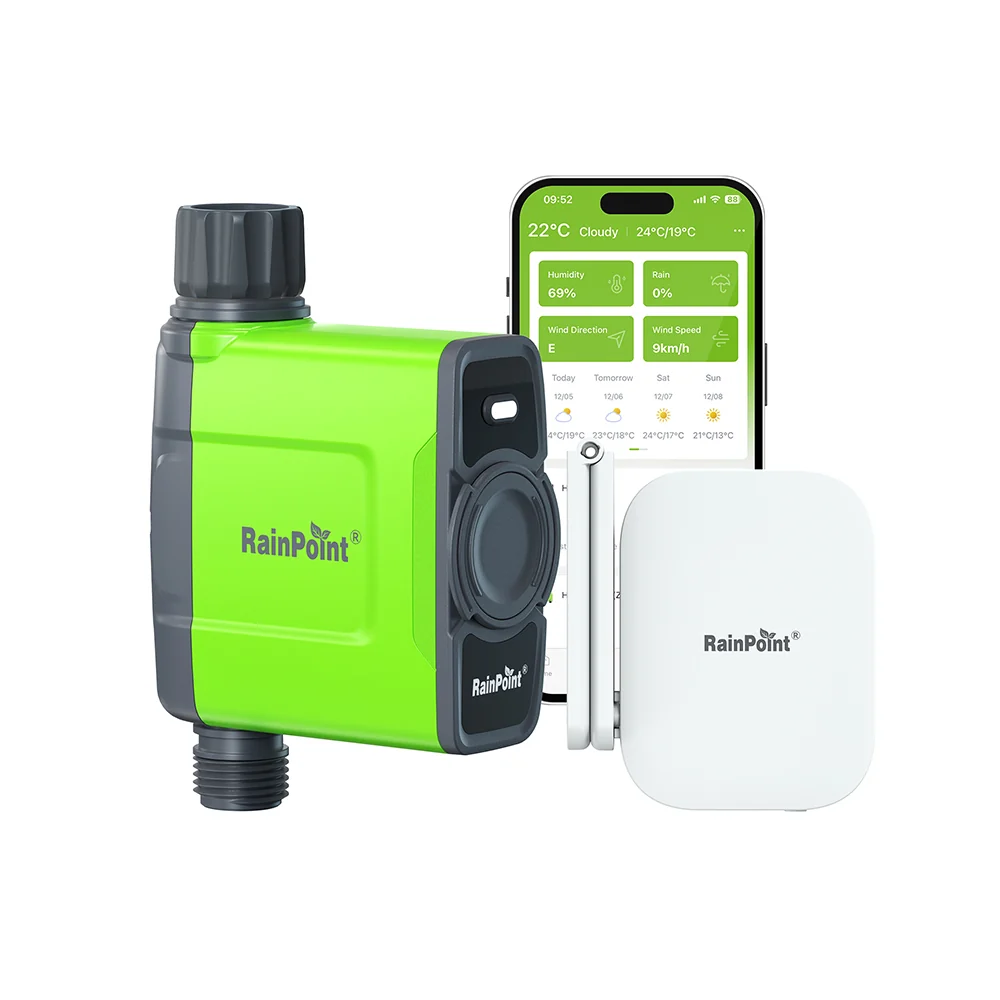
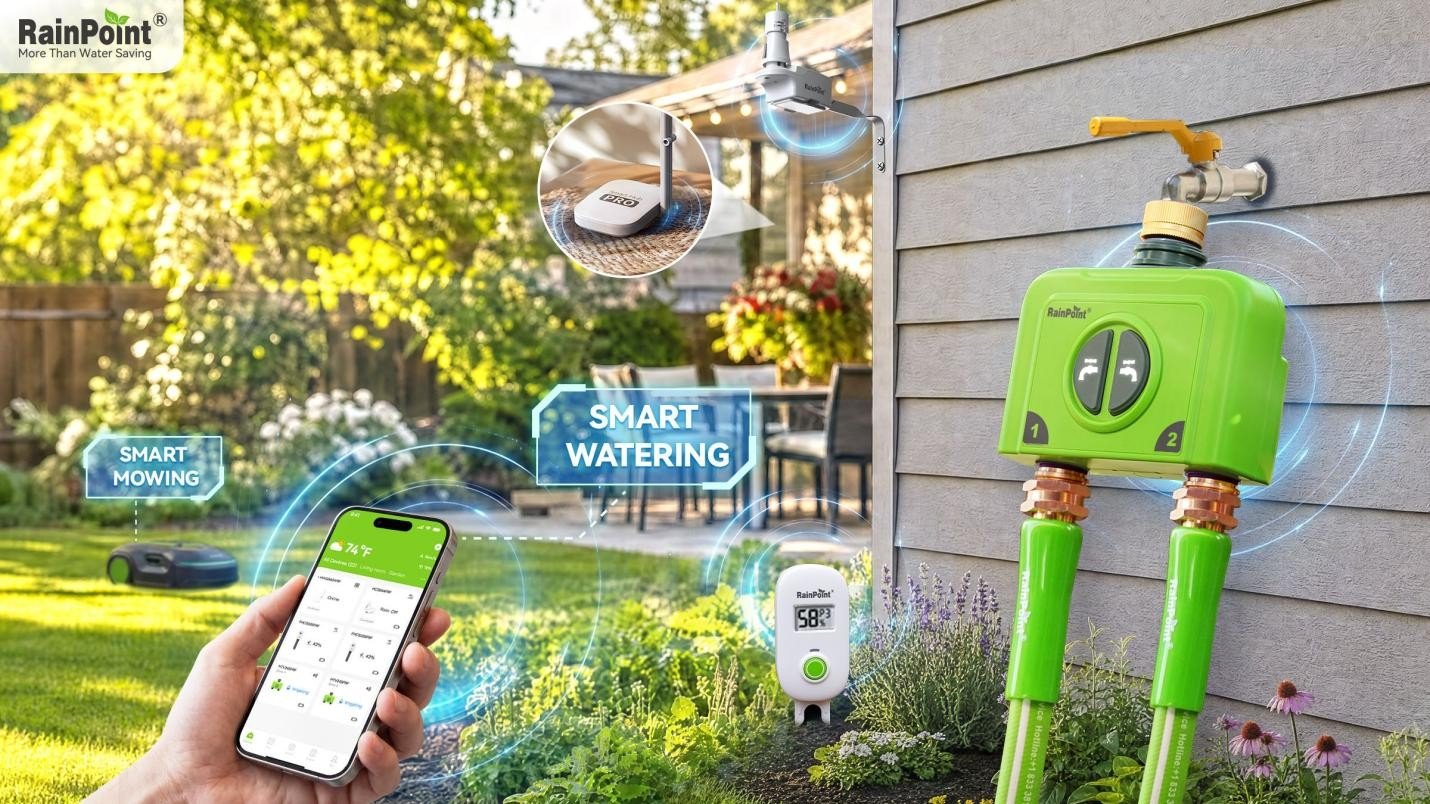
That’s the gap RainPoint is trying to close. Instead of building another standalone timer, the company has put together a connected system — a gateway, a dual-zone smart water timer, a soil-moisture sensor, a rain sensor, and the RainPoint Home app — designed to work together rather than in isolation. RainPoint calls this its Smart Watering Eco-system, and after digging into how the pieces fit together, it’s a useful case study in what “smart lawn care” should actually mean once you get past the marketing.
The Problem With Fixed Schedules
Most irrigation timers, smart or not, are still running on a fixed-schedule mentality: water Tuesday, Thursday, and Saturday mornings for 20 minutes, rain or shine. Even timers with a weather API bolted on tend to make one blunt adjustment — skip today, water tomorrow — without any real sense of what’s happening at root level in the soil.
The problem is that lawns and gardens don’t run on a calendar. A soaking rain on Monday can make Thursday’s scheduled watering completely unnecessary. A hot, dry stretch can leave grass stressed two days before the next scheduled cycle. A shaded flower bed and a sun-baked stretch of lawn twenty feet away have completely different water needs, but a single-zone timer waters them identically. Fixed schedules aren’t wrong, exactly — they’re just working with less information than they could be.
A connected, condition-responsive system flips that logic. Instead of watering on a preset clock regardless of conditions, it uses live inputs — soil moisture, rainfall, and zone-specific settings — to help determine whether watering is needed and to adjust, delay, or skip a cycle based on the rules the user has configured. That’s the core premise behind RainPoint’s approach, and it’s where the individual hardware pieces start to matter.
What’s Actually in the Ecosystem
It’s worth being clear about what RainPoint is and isn’t. It’s not one smart device that does everything — it’s a coordinated set of components, each handling a specific job:
- The gateway acts as the hub, connecting to the home Wi-Fi network and coordinating communication among the compatible RainPoint devices.
- The dual-zone smart water timer controls watering for two separate areas independently — say, the front lawn and a vegetable garden — instead of forcing identical schedules on zones with different needs.
- The soil-moisture sensor reads actual ground conditions rather than assuming them, giving the system a real data point instead of a guess.
- The rain sensor detects rainfall, allowing the system to delay or skip a scheduled watering cycle when rain is detected.
- The RainPoint Home app ties it all together — showing zone status, letting you build and edit schedules, and giving you remote control from a phone.
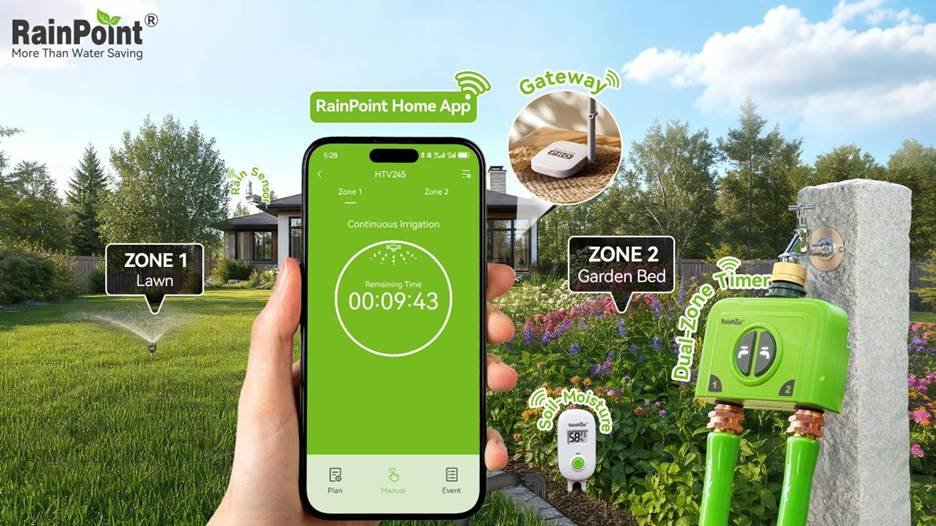
Individually, none of these is a novel concept — soil sensors and rain sensors have existed for years. What’s different is treating them as inputs to one system instead of separate gadgets that don’t talk to each other. A rain sensor that can’t tell your zone timer to skip a cycle isn’t saving you much. A soil sensor that just displays a number on an app, with no automated action behind it, is a nice-to-know rather than a nice-to-have. The value of RainPoint’s approach is in the connective tissue between the parts.
The 3C Framework: Connect, Control, Continue
RainPoint frames the ecosystem around three ideas, and they roughly map to the lifecycle of actually adopting a system like this.
Connect is the starting point — bringing your water source, the individual devices, environmental data, and your plants into a single system you can see and manage from one place. This is the “getting started” phase, and it’s where a lot of smart-home products stumble: too many apps, too many separate setups, too much friction before you see any benefit. Folding everything into one gateway and one app is meant to lower that barrier.
Control is the day-to-day payoff. Once the system is connected, you get zone-by-zone command over watering — adjusting schedules remotely, responding to a soil reading, or letting a rain delay kick in automatically instead of you remembering to turn off a manual timer before a storm. This is where the anxiety of “did I overwater, did I underwater, did I forget to turn it back on” gets replaced by a system that’s at least partially watching conditions on your behalf.
Continue is the long game: reliable watering, season after season, without the setup having to be redone every spring. As seasons shift and watering needs change, the idea is that the system keeps working with less manual re-tuning than a purely mechanical timer would require.
It’s a tidy framework, and it’s worth reading with a practical eye rather than a purely promotional one. “Connect, Control, Continue” is really just “setup, use, maintain” dressed in brand language — but the underlying logic (make setup easy, make daily control genuinely useful, make it low-maintenance over time) is the right set of questions to ask about any smart yard product, RainPoint included.
Where This Fits in an Automated Yard
We’ve written before about robot mowers as the visible, headline piece of yard automation — the device you can watch working. Irrigation is the less glamorous half, but arguably the more consequential one, since water use touches your utility bill, your local water restrictions, and how your lawn and garden actually look through a dry summer.
A system like RainPoint’s is aimed at a specific set of situations: a lawn with genuinely different zones (full sun vs. shade, lawn vs. garden bed), a household that travels enough that a “set it and forget it, but actually responsive” system has real value, or simply a homeowner who’s tired of manually adjusting a timer every time the forecast changes. If your yard is small, uniform, and you’re happy watering by hand or with a basic hose timer, the case for a multi-component ecosystem is weaker — this is a tool built for complexity, not a replacement for a five-minute daily hand-water on a patio planter.
It’s also worth being realistic about what “smart” buys you here. A soil-moisture sensor and rain sensor can meaningfully reduce unnecessary watering cycles, but the actual water savings for any given yard will depend on your climate, your existing schedule’s inefficiency, how the zones are set up, and how consistently the system is maintained. There’s no universal percentage that applies to every lawn, and treating a connected system as a substitute for basic yard-care judgment — right plant for the zone, reasonable schedule as a baseline, sensors checked periodically — will get you further than treating it as a fully hands-off fix.
Setup and Everyday Use
In practice, getting a system like this running involves connecting the gateway to home Wi-Fi, pairing the water timer and sensors through the RainPoint Home app, and assigning zones — this bed gets one schedule, that stretch of lawn gets another. From there, the app becomes the control surface: check soil readings, see whether a rain delay triggered, adjust a schedule for a zone that’s drying out faster than expected, or just glance at a watering history to see what actually happened last week instead of guessing.
RainPoint first showed this integrated approach publicly at CES 2026, positioning it as an all-in-one home irrigation system rather than a single gadget — and that framing is really the point. The interesting shift in smart yard care right now isn’t any one sensor or any one app; it’s the move toward treating watering, mowing, and eventually broader yard maintenance as parts of one connected system rather than a shelf of unrelated gadgets.
The Bigger Picture
RainPoint first showed this integrated approach publicly at CES 2026, positioning it as an all-in-one home irrigation system rather than a single gadget — and that framing is really the point. The interesting shift in smart yard care right now isn’t any one sensor or any one app; it’s the move toward treating watering, mowing, and eventually broader yard maintenance as parts of one connected system rather than a shelf of unrelated gadgets.
Whether RainPoint’s specific execution is the right fit depends on your yard, your zones, and how much you want to manage from an app versus a dial. But the underlying idea — that a rain sensor should actually talk to your water timer, that a soil reading should be able to change a schedule automatically, that “smart” should mean coordinated rather than just connected-to-Wi-Fi — is the right direction for where lawn and garden tech is headed.
If you’re curious about the specific hardware and current pricing, RainPoint’s Smart Watering Eco-system product page has the full breakdown of what’s included.