
If you’ve started shopping for a smart irrigation controller, you’ve almost certainly run into these two names. RainPoint has built a reputation as the budget-friendly newcomer with a surprisingly deep feature set, while Orbit B-hyve is the more established player that’s been fine-tuning its irrigation lineup for years. Both promise the same basic pitch: stop guessing about when to water, let weather data and an app do the thinking, and cut your water bill in the process.
But “smart sprinkler controller” covers a lot of ground, and the two brands don’t compete head-on in every category. This guide breaks down how they stack up on zones, weather intelligence, connectivity, ease of setup, and price, so you can figure out which one actually fits your yard.
The Quick Answer
If you want the shortest possible version: RainPoint tends to win on price and on flexibility for hose-end and small-yard setups, while Orbit B-hyve wins on zone scalability, hardwired reliability, and smart-home ecosystem depth. A reviewer who put the RainPoint through its paces against Rain Bird’s ARC6 controller found that RainPoint offered manual zone control, soil moisture-based watering, and voice commands, making for a more comprehensive watering experience, though the unit runs larger and heavier and its interface can feel complex for beginners. Orbit, meanwhile, has spent years building out models that scale from 4 zones to 16, giving it an edge for anyone with a genuinely large or complex property.
Neither brand is a bad choice. The right pick really comes down to how big your yard is, whether you’re working with an existing hardwired sprinkler system or a hose-based setup, and how deep you want to go into the smart-home rabbit hole.
Zone Count and Scalability
This is where the two brands diverge the most.
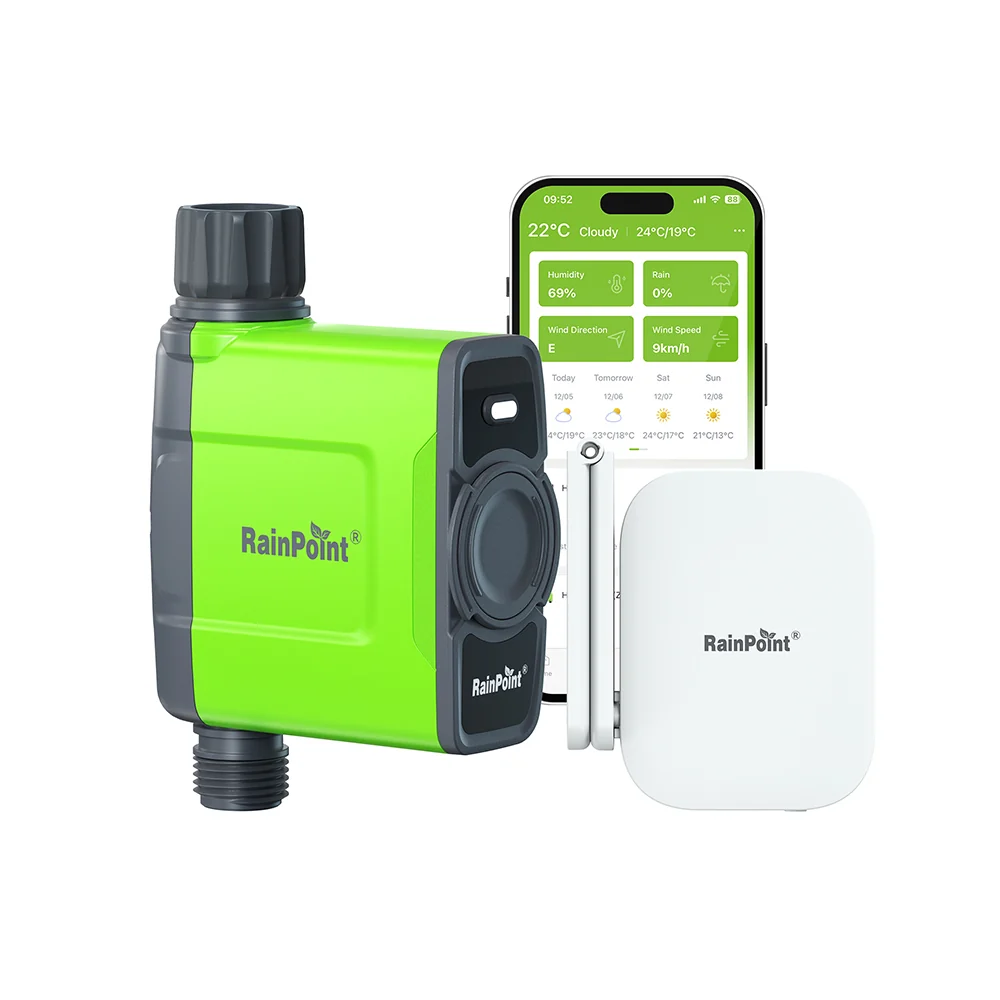
RainPoint built its reputation on smaller setups. Its most common models are 1- and 2-zone WiFi water timers designed to sit at the end of a garden hose, and it’s now expanding into full 24VAC hardwired controllers as well. RainPoint’s 8-zone WiFi controller is designed as a standard 24VAC unit that comes with wall-mount screws and a transformer, is compatible with most existing sprinkler systems, and connects directly to existing sprinkler valves and rain sensors, with an installation time under 15 minutes. That said, RainPoint’s lineup is still noticeably thinner than Orbit’s when it comes to large-property options, and reviewers have flagged the brand’s limited product range as a tradeoff for buyers who might eventually want more zones or more customization.
Orbit B-hyve offers one of the widest zone ranges on the market. You can find B-hyve controllers in 4-, 6-, 8-, 12-, and even 16-zone configurations, plus the higher-end B-hyve XR line built specifically for larger or more demanding properties. The 12-station model, for example, is built for 24VAC sprinkler and drip irrigation systems with up to 12 zones, using hyperlocal weather data to automatically adjust watering schedules and delay watering during rain, wind, or freezing conditions. If your property has more than a handful of zones, sprawling flower beds, a vegetable garden, and a drip line for the shrubs, Orbit simply has more headroom to grow into.
Bottom line: small yard or a hose-fed setup, RainPoint is plenty. Multi-zone hardwired system on a larger lot, Orbit’s scalability wins.
Weather Intelligence and Water Savings
Both brands lean hard on “smart” watering that adjusts to real-world conditions instead of running on a rigid clock, but they brand it differently.
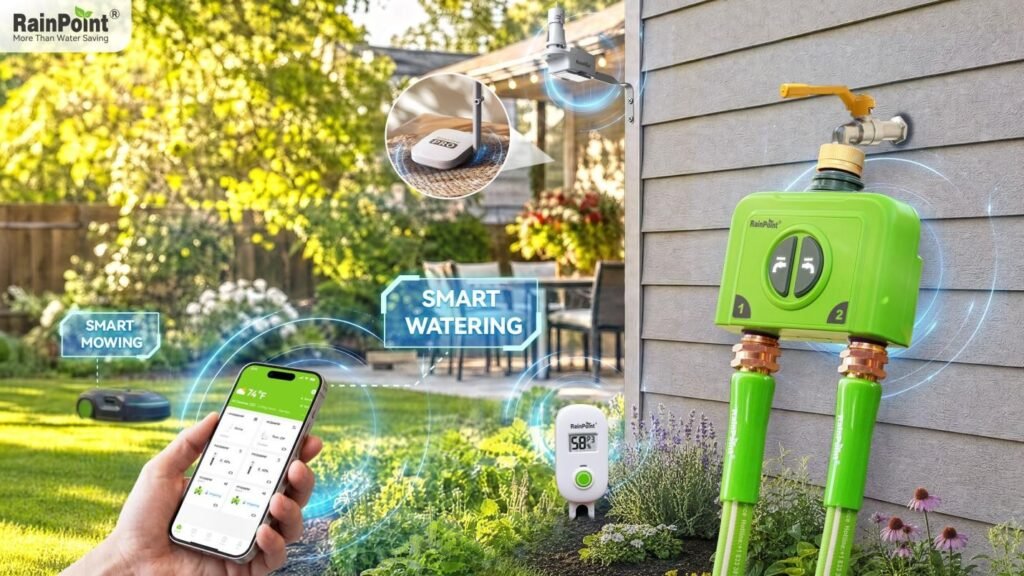
RainPoint’s weather features go under the “Rain Auto-Skip” name. The controller checks local weather data and automatically pauses watering during rain or freezing conditions, resuming once the weather improves. RainPoint has also been pushing further into precision watering with its newer Smart+ ecosystem, which layers in soil and moisture sensing on top of weather data. The company’s 2026 CES announcement described a system built around three intelligent watering modes, normal irrigation, cycle/soak, and misting, along with a soil moisture meter that monitors conditions across the yard, and a companion hub that provides smart watering based on site conditions like slope, soil type, sun and shade exposure, and live weather feeds, while layering in automated delays for rain, wind, and freezing temperatures.
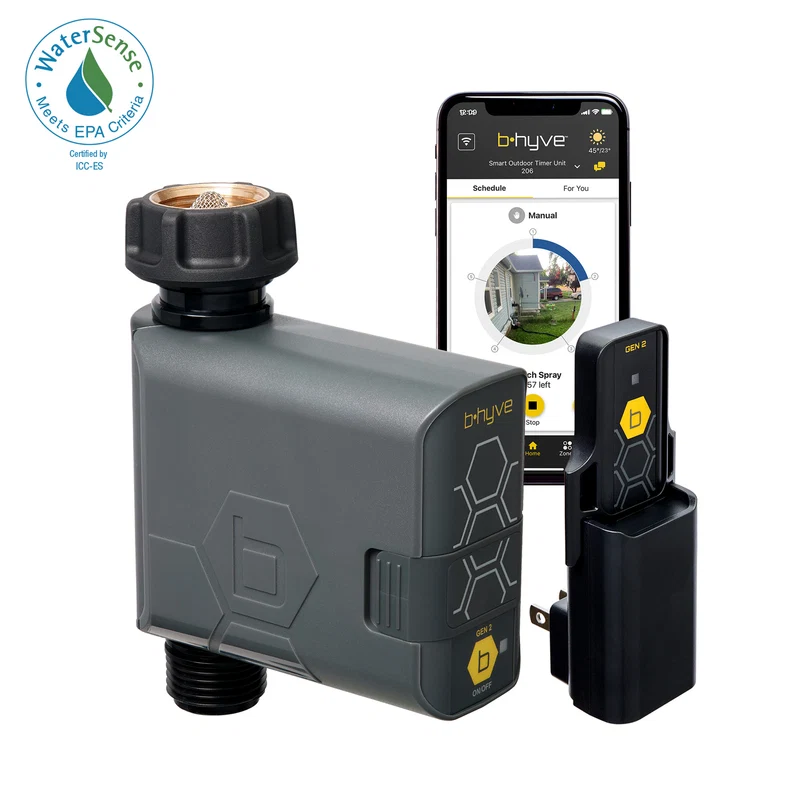
Orbit’s version of this is called WeatherSense, and it’s been a core part of the B-hyve platform since the beginning. The system receives local weather data and automatically adjusts watering schedules to deliver the right amount of water, pausing for rain and adjusting up or down for hot or cold conditions. It’s a more mature, more predictable implementation than RainPoint’s newer Smart+ layer, mostly because Orbit has had years of field data and app updates to work out the kinks.
For most homeowners, both systems will meaningfully cut down on wasted water and prevent the classic “sprinklers running during a rainstorm” problem. RainPoint’s newer hardware pushes further into soil-level precision, but Orbit’s WeatherSense has the track record.
Connectivity and Smart Home Integration
Orbit has the deeper bench here. B-hyve controllers typically run dual radios, both Bluetooth and 2.4GHz WiFi, for setup and everyday control, and the higher-end XR models add 5GHz WiFi for a stronger, more interference-resistant connection. On top of that, B-hyve plugs into a wider smart-home and irrigation-accessory ecosystem: it’s compatible with the Flume smart flow meter, the Guardian smart water shut-off valve, and both Google and Alexa smart home control.
RainPoint isn’t far behind on the basics. Its controllers connect over WiFi and typically support Alexa and Google Home for voice commands, and the company has been building out its own hub-based Smart+ ecosystem to link sprinklers, soil sensors, and rain sensors under one app. Where RainPoint has recently pulled ahead on paper is signal range: its newer gateway hardware advertises a long-range gateway rated to roughly 492 feet, which is a meaningful advantage if your controller lives in a garage or basement far from your router.
Neither brand requires a subscription to use core scheduling features, which is worth noting since some competing smart controllers do gate advanced weather features behind a paywall.
Setup and Everyday Use
Installation is genuinely simple on both sides. RainPoint’s hardwired 8-zone model is rated for under 15 minutes to install, and Orbit’s XR line advertises similarly fast setup, helped along by push-fit wire terminals and a built-in bubble level for mounting.
Where the two diverge is app polish and long-term reliability. A side-by-side comparison from one smart-home review site noted that RainPoint’s performance consistency is generally stronger and the unit is less finicky to program, while B-hyve can be a bit more troublesome to set up and sometimes needs extra troubleshooting to get dialed in. On the flip side, that same comparison pointed out that RainPoint’s product catalog is more limited overall, with fewer zone options and less customization available than the B-hyve lineup offers.
In practice, this means: if you want the simplest possible experience for a small yard and don’t need a lot of customization, RainPoint tends to “just work.” If you want granular control across a large property, split into multiple watering programs, you’ll spend a bit more time in the B-hyve app but get more configuration options once you’re set up.
Price
This is one of RainPoint’s clearest advantages. The brand’s hose-end and small-zone timers routinely start well under $50, and even its bundled Smart+ packages with a hub, rain sensor, and moisture meter tend to land under $220 at the high end. Orbit’s entry-level indoor 4-zone controller runs a similar price to RainPoint’s cheaper offerings, but Orbit’s pricing climbs quickly as you move up in zones: an 8-zone indoor unit lands in the high-$80s, a 6-station indoor/outdoor model is priced similarly, and the 16-station B-hyve XR runs closer to $160.
So the price comparison really depends on what you’re buying. At the low end (1-2 zones, hose-fed), RainPoint is usually cheaper. In the mid-range (4-8 zones, indoor), the two brands land close to each other. At the high end (12+ zones, outdoor-rated), Orbit is really your only realistic option since RainPoint doesn’t field as many large-zone controllers.
Durability and Build Quality
Orbit’s outdoor-rated B-hyve models are built for permanent installation, with locking, weatherproof cabinets designed to live outside year-round next to your existing valve box. That’s a meaningful advantage if you don’t want to run wiring back into a garage or basement.
RainPoint’s outdoor hardware has been catching up fast, with several current products emphasizing brass fittings and weather-resistant housings for longevity. One review noted that a RainPoint irrigation timer’s brass construction helps ensure durability under outdoor conditions, though the same review flagged that the unit is on the larger and heavier side, which could matter if you’re mounting it somewhere space-constrained.
Comparison at a Glance
| Category | RainPoint | Orbit B-hyve |
|---|---|---|
| Zone range | Mostly 1-8 zones (hose-end and hardwired) | 4-16 zones across multiple lines |
| Weather intelligence | Rain Auto-Skip, expanding Smart+ soil/weather ecosystem | WeatherSense, mature and widely tested |
| Connectivity | WiFi, Alexa/Google, long-range gateway option | Bluetooth + WiFi (dual-band on XR), Alexa/Google, Flume/Guardian integration |
| Best for | Small yards, hose-fed systems, budget buyers | Larger properties, hardwired systems, smart-home builders |
| Typical price range | Roughly $45-$220 | Roughly $50-$160+ depending on zones |
| Setup | Very fast, described as easy for beginners | Fast, but app can take more tuning to dial in |
Which One Should You Buy?
- Small yard, garden beds, or a hose-fed sprinkler setup: RainPoint is the more cost-effective, easier-to-love option, especially if you don’t need more than a couple of zones.
- Larger property with an existing hardwired 24VAC system and 8+ zones: Orbit B-hyve’s scalability and outdoor-rated hardware make it the safer long-term bet.
- Deep into Alexa, Google Home, or a broader smart-water ecosystem: Orbit’s compatibility with accessories like Flume and Guardian gives it an edge if you want everything talking to each other.
- Chasing the newest soil-and-weather precision watering tech: RainPoint’s Smart+ ecosystem is where the brand is investing right now, and it’s worth a look if hyper-local moisture data matters to you.
Either controller will save you water and spare you the chore of manually turning sprinklers on and off. The real decision point isn’t which brand is “better” in the abstract, it’s how many zones your yard actually needs and whether you’re working with hardwired valves or a hose-end setup. Match the controller to your yard first, and the rest of the features will fall into place.