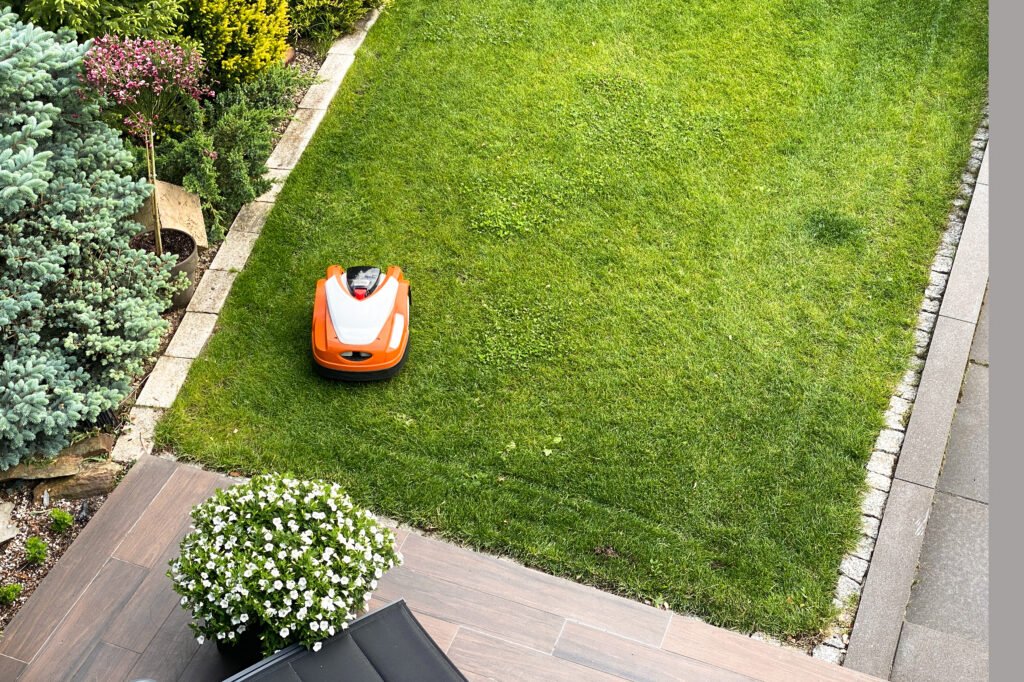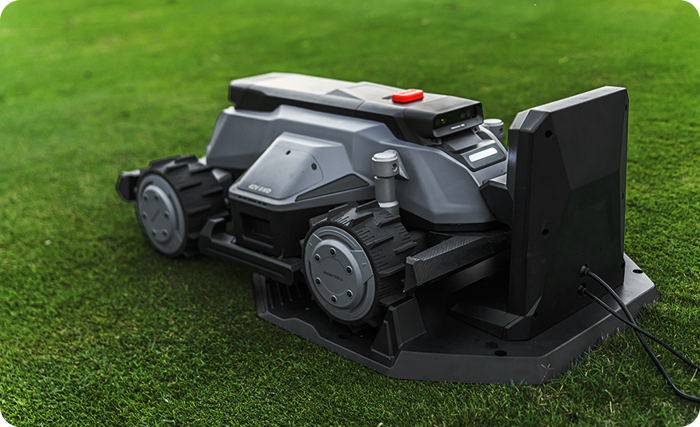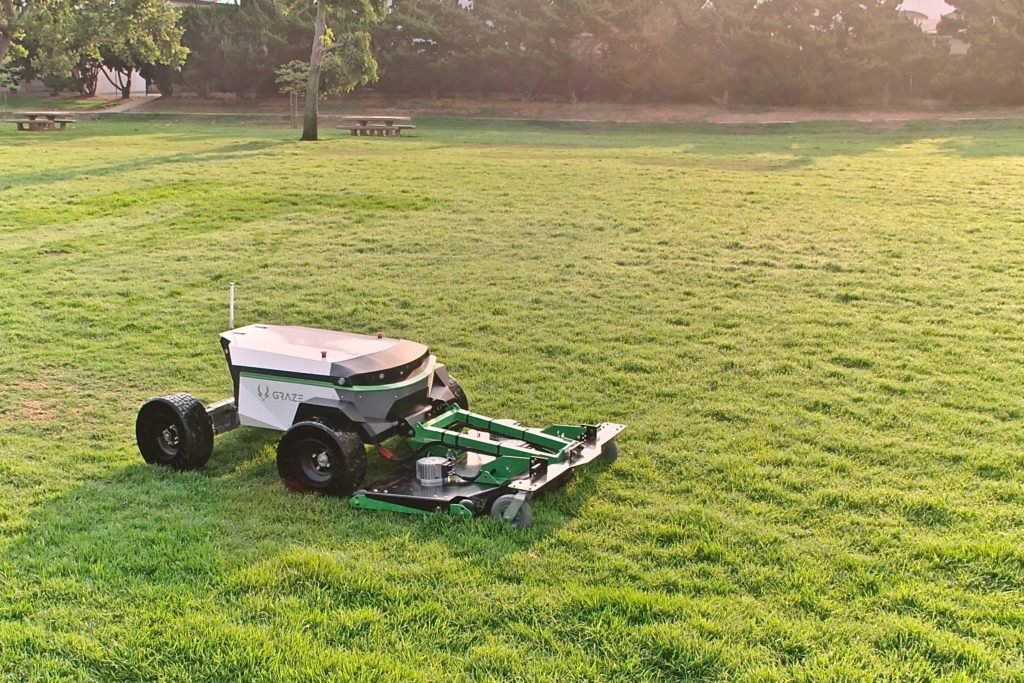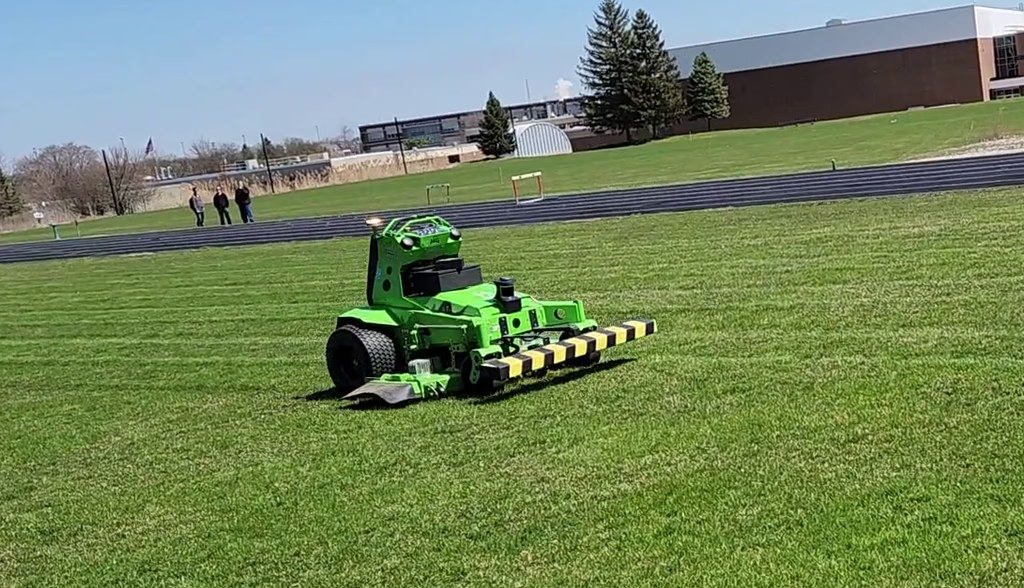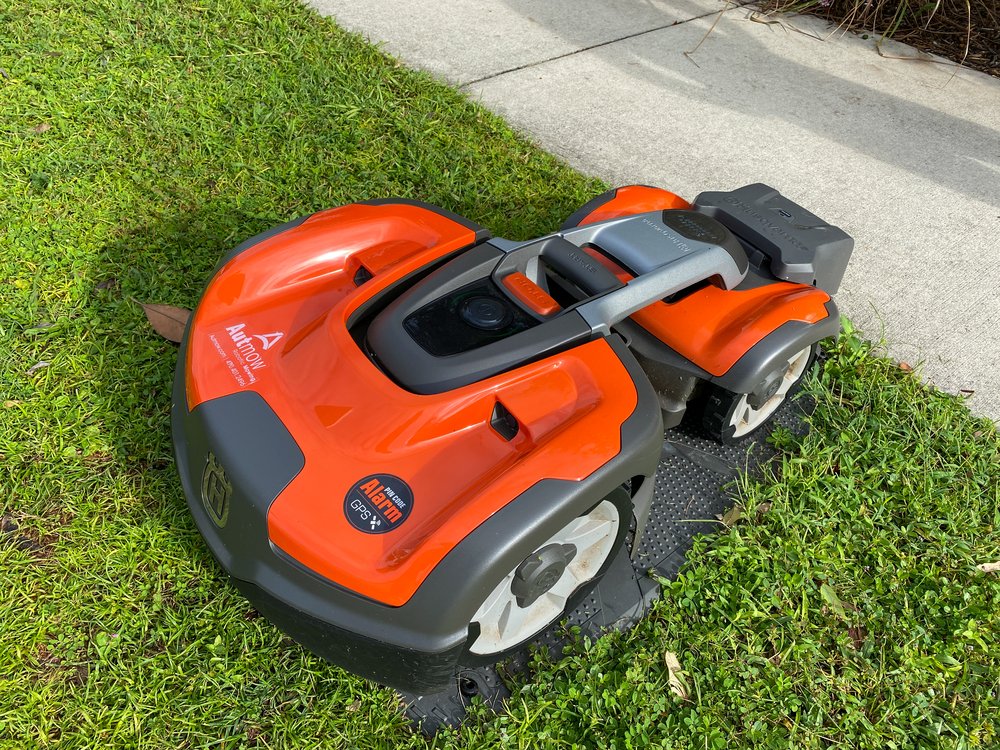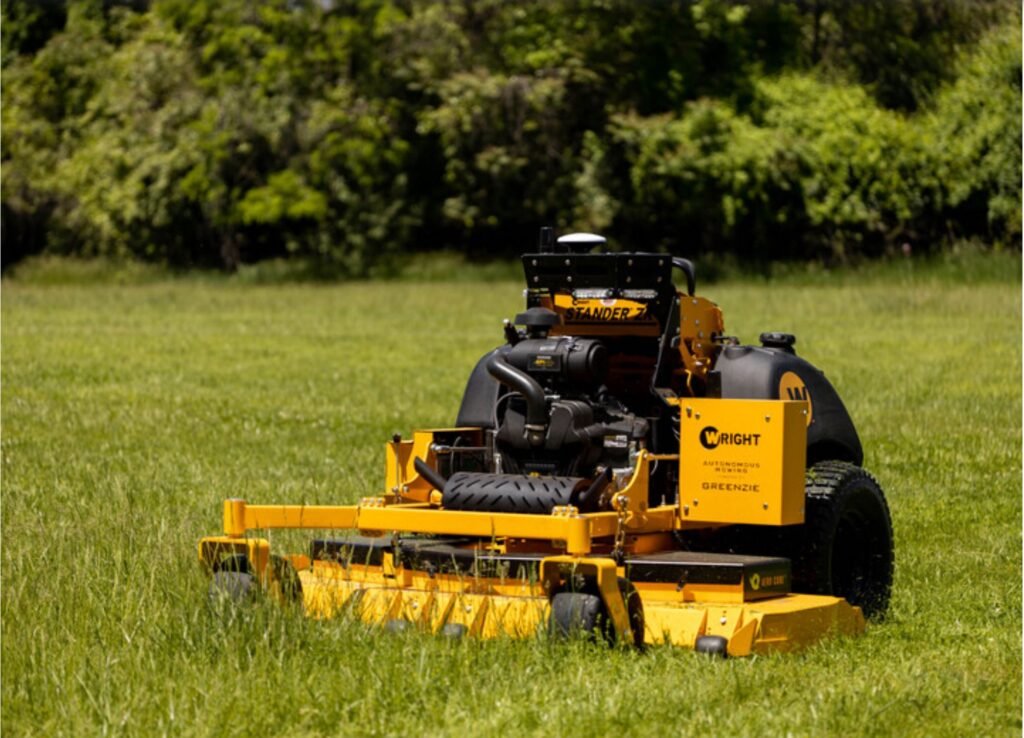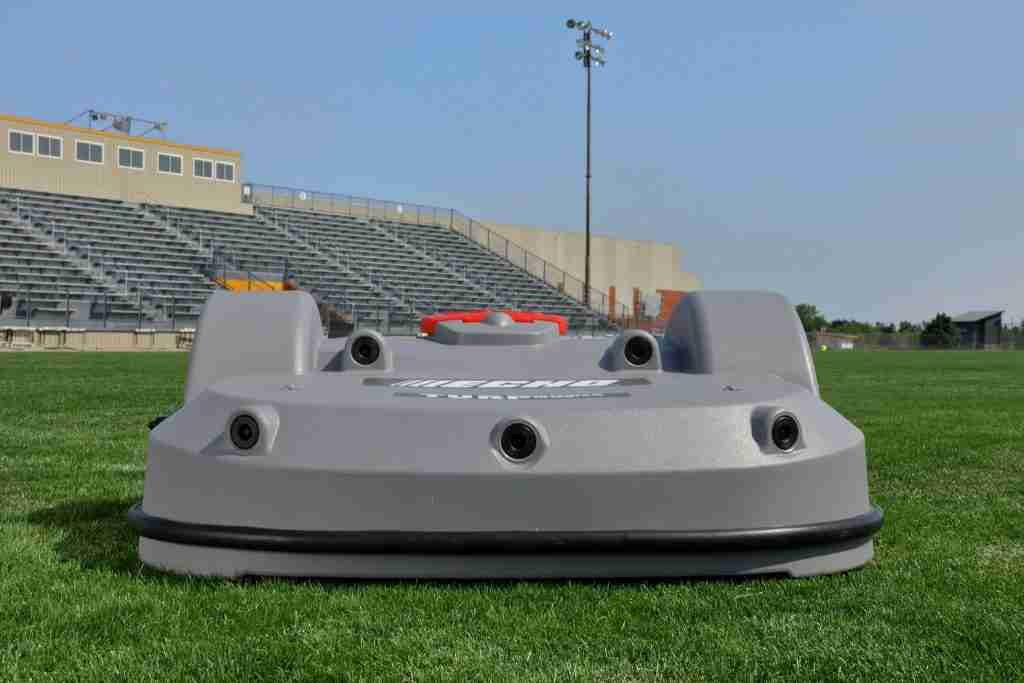

Most commercial robot mowers fall into one of two camps. Fixed-site robots like the Husqvarna CEORA live on one property and depend on satellite positioning. Autonomous route mowers like the Kress Voyager or Exmark Turf Tracer look like zero-turns and get trailered from site to site with a crew. The PANDAG G1 tries to sit in between: a 48-inch, battery-electric robot that docks and recharges on its own, navigates with LiDAR and AI vision on top of RTK, and swaps attachments on a common chassis.
We watched the G1 mow for about two hours on a 140-acre farm near Charlottesville, Virginia. Below is what PANDAG claims, what stood out, the questions any buyer should ask, and how it compares to the rest of the commercial field.
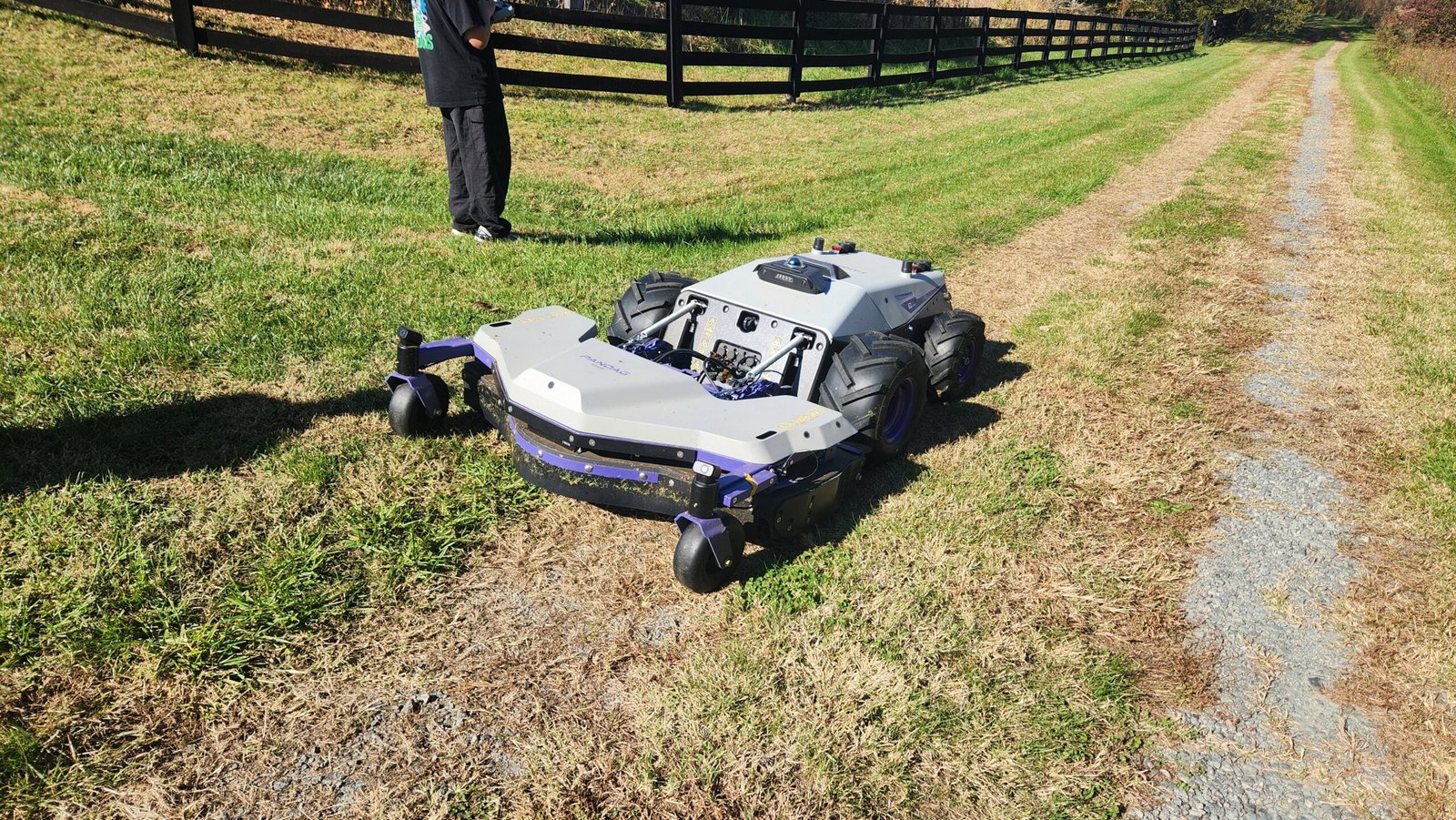
The PANDAG G1 working along a fence line and farm path near Charlottesville, Virginia.
PANDAG G1 at a Glance
| Type | Modular commercial robotic mower, battery electric |
| Coverage | Up to 12 acres per day (manufacturer claim) |
| Cutting width | 48 in (M1500 deck, 3 blade discs, side discharge) |
| Cutting height | 1.5 to 4.5 in (M1500 deck) |
| Max slope | 78% (38°) |
| Battery | 8 kWh lithium; auto-returns to charge |
| Runtime | Up to about 6 hours continuous (manufacturer claim) |
| Navigation | LiDAR + AI vision fusion, IMU, network RTK over 4G (no base station) |
| Weight / speed | 330 kg (about 728 lb); under 4.5 km/h (about 2.8 mph) |
| Fleet tools | App manages 100+ site maps, 24/7 remote monitoring, handheld remote |
| Modules | Mowing deck, trimmer, spike and all-terrain tires |
| Price | About $30,000 (sold through dealers) |
What Makes the G1 Different
LiDAR and Vision, Not Just Satellites
Most large-area commercial robots rely on RTK-GNSS positioning, which works beautifully on open sports fields and struggles under tree canopy or next to tall buildings. The G1 fuses LiDAR and AI vision with network RTK and an inertial measurement unit, so it can keep its position and detect obstacles when the satellite signal gets weak. PANDAG says the system recognizes people, benches, trees, and other obstacles in real time and steers around them.
It also skips the on-site reference station that systems like Husqvarna’s EPOS require. The G1 pulls RTK corrections over a 4G connection (NTRIP), which simplifies setup — though it does mean you’re depending on cellular coverage and, typically, a data subscription.
A Modular Platform
The G1 is built as a common body unit with swappable modules. Today that means the 48-inch M1500 mowing deck, a trimmer module for edges, fence lines, and around trees, plus spike tires for steep or slick ground and all-terrain tires for everyday work. PANDAG has said spraying, transport, and snow removal modules are in development, but those aren’t shipping yet, so don’t factor them into a purchase decision.
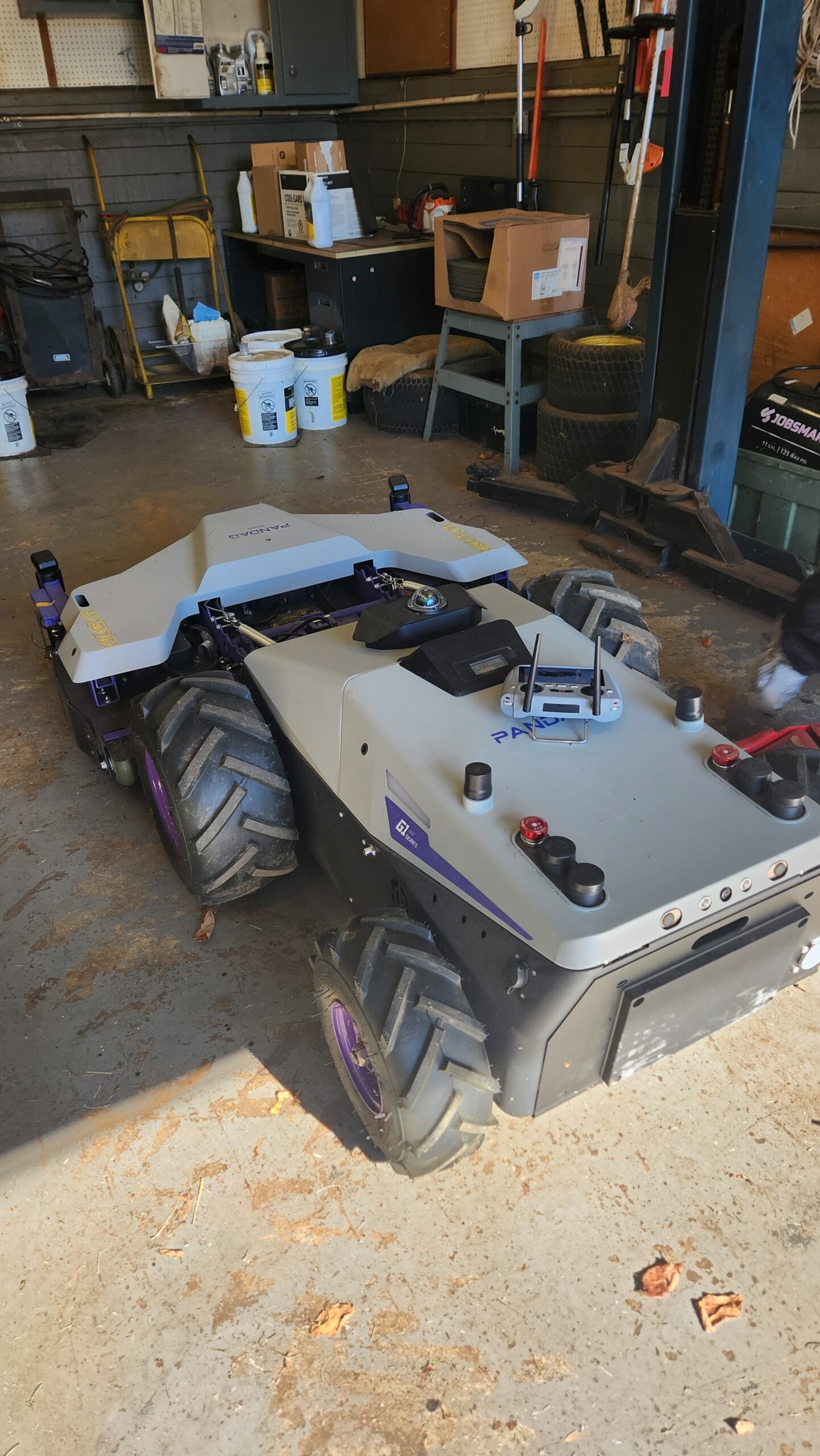 | 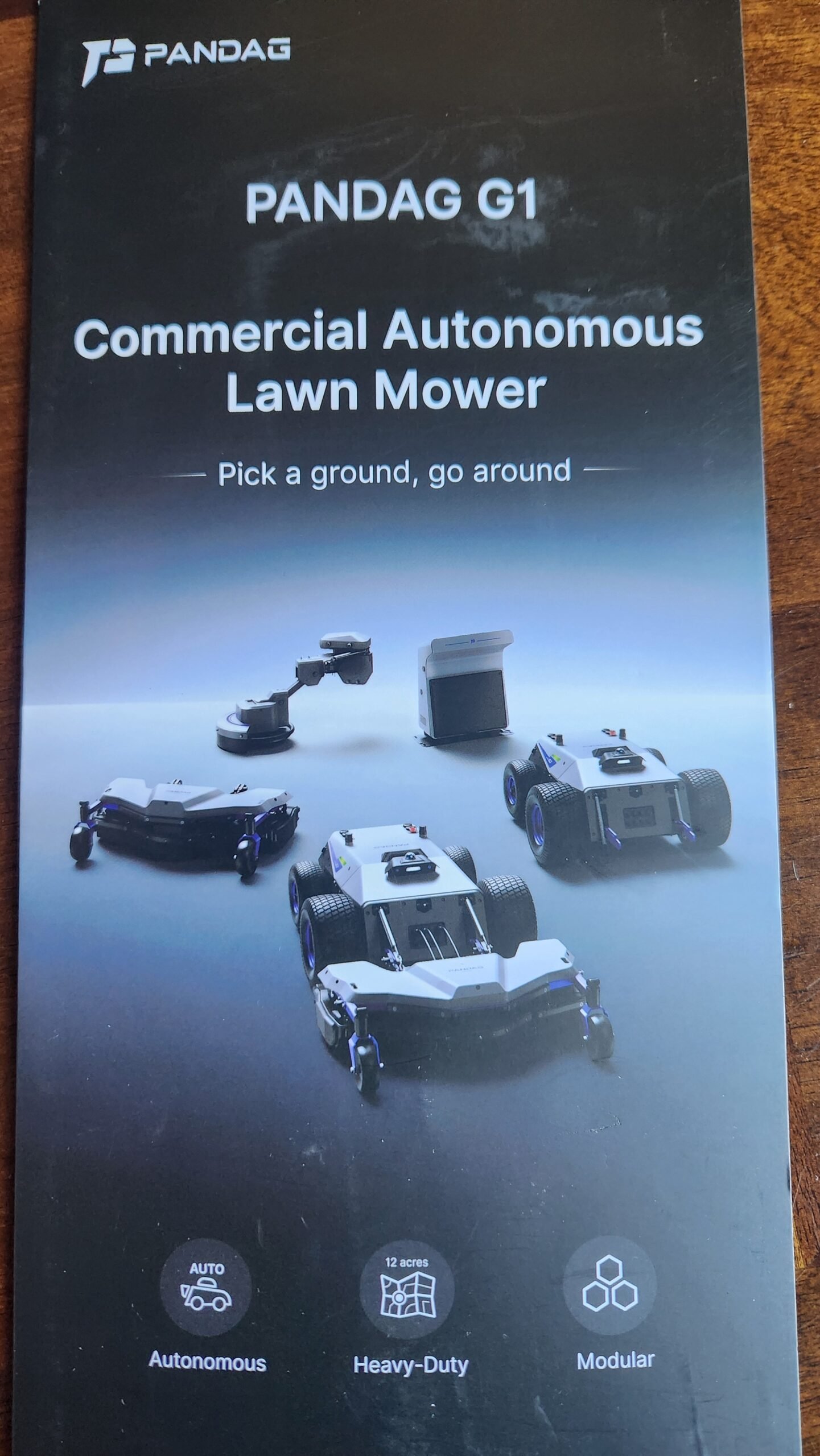 |
Left: the G1 body unit with all-terrain tires and its handheld remote. Right: PANDAG’s brochure shows the modular system built around that common chassis.
Big Battery, Big Deck, Real Slope Rating
An 8 kWh battery and a 48-inch, three-disc deck put the G1 in a different class from fixed-site robots with 10- to 27-inch cuts. Its 78% slope rating is also far beyond most large-area robots, many of which are rated for 20% to 45%. That makes it a candidate for parks with berms, detention ponds, roadside banks, and golf roughs where other robots can’t go.

PANDAG’s brochure lists the headline numbers: 6 hours of continuous runtime, up to 12 acres per day, 78% slopes, and a 48-inch cut.
Fleet Software Built for Multiple Sites
PANDAG’s app can store and switch between more than 100 site maps, with remote monitoring around the clock. That matters for contractors and municipalities that want one machine (or a small fleet) working across several properties rather than living permanently on one lawn.
Seeing It in Action in Charlottesville
We spent about two hours watching the G1 work on a 140-acre private farm near Charlottesville, Virginia. It mowed a real mix of terrain: open lawn, walking paths, and tight runs along fence lines. A few things stood out:
- Rugged yet agile. At over 700 pounds, it’s clearly built to take a beating, yet it maneuvered along paths and fence lines more nimbly than its size suggests.
- Super quiet. For a 48-inch commercial machine, it was remarkably quiet — a real advantage for parks, campuses, and early-morning or overnight mowing.
- Only a couple of hiccups. Over the two-hour observation, it struggled just a few times, and both were on very uneven ground. On normal turf, paths, and fence lines, it worked through the job without trouble. If your property has rough, rutted areas, ask about the spike-tire option and test it there during your demo.
Overall, it struck us as a very capable machine, especially for the price. More on that below.
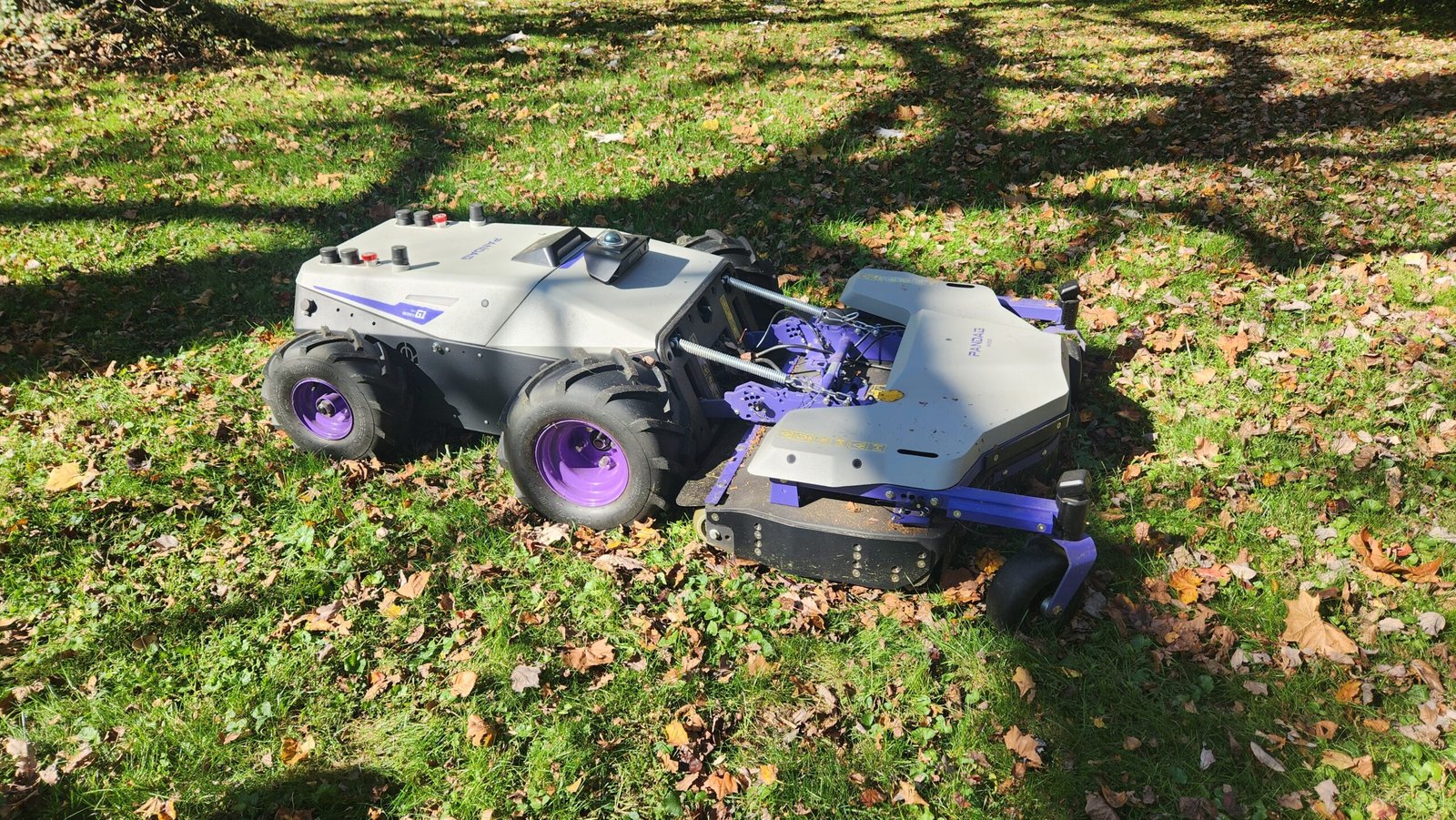
The G1’s 48-inch M1500 deck mowing through fall leaves under tree cover — the kind of area where LiDAR and vision help most.
Where It Fits Best
PANDAG markets the G1 for golf courses, municipal parks, sports fields, turf farms, and commercial landscaping. Based on its specs, it looks strongest for:
- Municipal parks and campuses with trees, benches, and paths that challenge satellite-only robots
- Golf roughs, surrounds, and slopes where its 78% climbing rating opens up areas other robots can’t handle
- Landscape contractors who want an autonomous machine they can move between multiple properties
- Overgrown or naturalized areas — PANDAG says the G1 can cut overgrowth several feet tall, well beyond what a typical robot mower attempts
It’s a weaker fit for golf fairways and elite sports turf that need a reel cut below 1 inch. The G1’s minimum cutting height on the M1500 deck is 1.5 inches, so look at autonomous reel mowers for that job.
Pros and Cons
What We Like
- Strong value at about $30,000, roughly half the price of autonomous commercial mowers from the big mower brands
- Quiet, rugged, and agile in our on-site observation
- LiDAR + vision navigation should hold up better under trees and near buildings than RTK-only robots
- No reference station to install, thanks to network RTK over 4G
- Steep-slope capability at a 78% rating, with spike tires for traction
- 48-inch deck and 8 kWh battery for genuine commercial output
- Modular trimmer tackles edges and obstacles robots usually leave behind
- Multi-site fleet app with 100+ maps and remote monitoring
- Battery electric, so it’s quiet and emission-free for parks, campuses, and night mowing
What to Ask About
- Price isn’t listed online. The G1 runs about $30,000 through dealers, but compare total first-year cost, including modules, cellular/RTK subscriptions, and service.
- Very uneven ground. The few times we saw it struggle were all on very rough, uneven terrain. Demo it on your roughest area.
- Spec inconsistencies. PANDAG’s own pages list runtime as both “6 hours continuous” and “up to 4 hours,” and slope as both 78% (38°) and 90% (42°). The printed brochure uses 6 hours and 78%, which are the figures we’ve used here, but get the numbers for your configuration in writing.
- Young brand, limited US dealer network. PANDAG launched publicly at CES 2026 and is still recruiting dealers. Ask who services the machine locally and how fast.
- Heavy machine. At about 728 lb, it needs a trailer or a full-size pickup with ramps to move between sites, and it may leave marks on soft or wet turf.
- Cellular dependency. Network RTK needs reliable 4G coverage on every property you mow.
- Future modules aren’t here yet. Spraying, transport, and snow removal are announced, not shipping.
- Warranty details aren’t published on PANDAG’s site. One reseller lists 24 months on the battery, motor, and electronic control system — confirm the terms with your dealer.
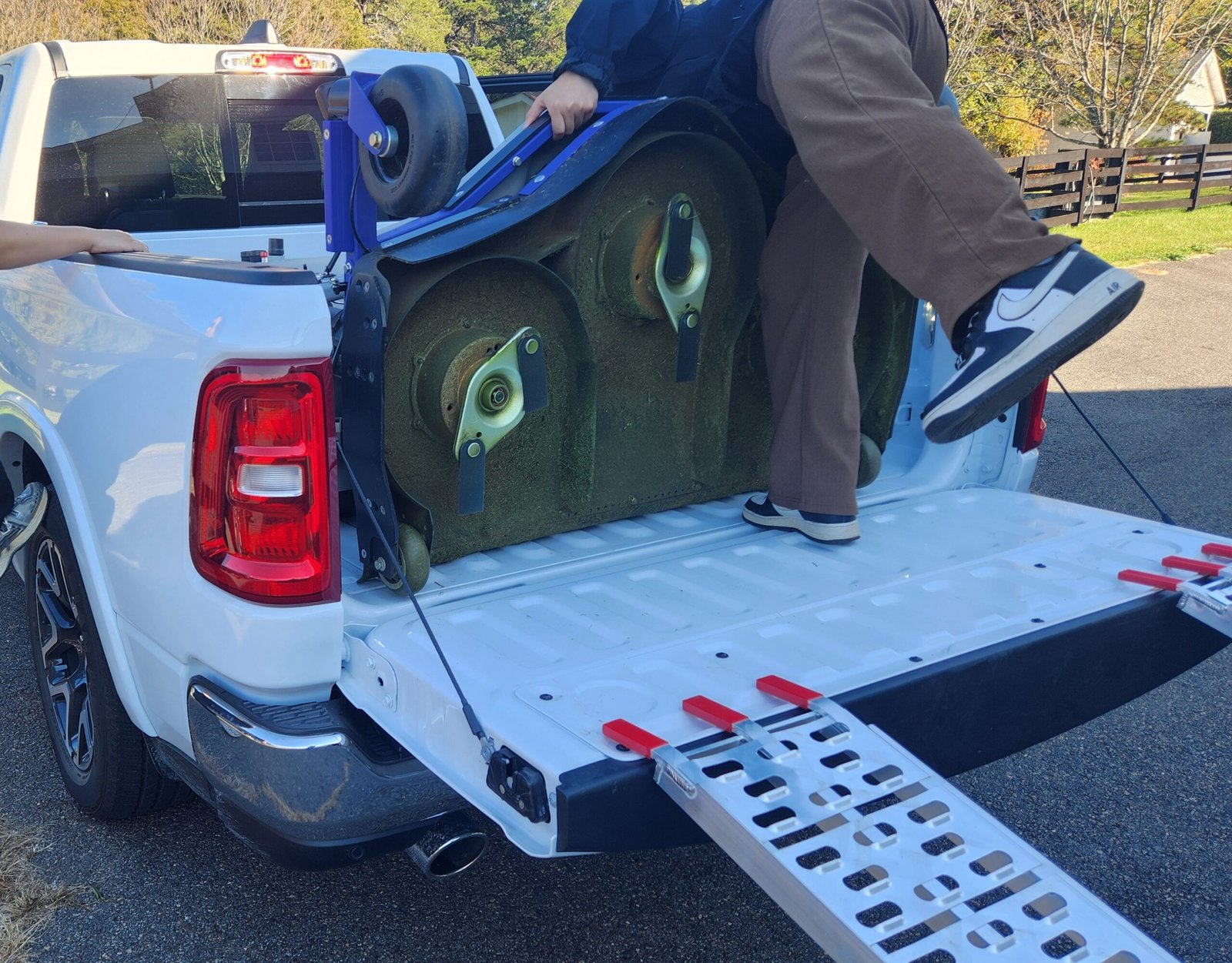
Loading the G1 into a pickup with ramps. This angle also shows the underside of the M1500 deck and its three blade discs.
PANDAG G1 vs. Other Commercial Robot Mowers
| Mower | Type | Cut Width | Max Slope | Navigation |
|---|---|---|---|---|
| PANDAG G1 | Modular large-area robot | 48 in | 78% | LiDAR + vision + network RTK |
| Husqvarna CEORA 546 EPOS | Large-area robot | 26.8 in | 20% | RTK-GNSS + reference station |
| Toro Turf Pro 500 | Large-area robot | 40.7 in | 45% | RTK-GNSS |
| Kress Voyager KR800 | Autonomous route mower | 40 in | 40% | RTK + sensors |
| FJDynamics RM21 | Large-area robot | 25 in | 36% | RTK-GNSS |
See the full side-by-side, with 29 commercial models and estimated prices, in our commercial robot mower specifications table. Or answer a few questions in the Commercial Robot Mower Finder to see whether the G1 makes your shortlist.
Cost and ROI
PANDAG doesn’t publish pricing online, but the G1 runs about $30,000 through dealers. That’s roughly half what you’ll pay for autonomous commercial mowers from the big mower brands — autonomous route mowers from Exmark, Kress, and Mean Green run about $50,000 to $65,000 each — and at the low end of the $30,000 to $55,000 range for large-area robots like the Husqvarna CEORA and Kress MasterSeries. Budget extra for subscriptions, service, and any add-on modules. Our commercial robotic mower price guide breaks down what drives that number. Once you have a quote, our break-even guide for commercial robot mowers shows how to compare it against your current labor, fuel, and equipment costs.
Frequently Asked Questions
How much does the PANDAG G1 cost?
The PANDAG G1 runs about $30,000 through dealers. PANDAG doesn’t list pricing online, and your total cost will depend on modules, subscriptions, and service.
How many acres can the PANDAG G1 mow?
PANDAG rates the G1 for up to 12 acres per day with its 48-inch deck. Actual output depends on cut height, grass density, slopes, and how complex the site is.
Does the PANDAG G1 need a boundary wire or base station?
No. It uses LiDAR, AI vision, and network RTK corrections delivered over 4G, so there’s no perimeter wire or on-site reference station.
Can the PANDAG G1 mow slopes?
Yes. PANDAG rates it for slopes up to 78% (38°), and optional spike tires add traction on steep or slippery ground.
Is the PANDAG G1 available in the US?
PANDAG says the G1 is in production and shipping to commercial fleets, and it holds FCC certification. The company is still building its dealer network, so contact PANDAG or a dealer to check availability in your area.
The Bottom Line
The PANDAG G1 is one of the more interesting commercial robot mowers to arrive in 2026. LiDAR-and-vision navigation, a 78% slope rating, a 48-inch deck, and a modular trimmer address the exact places where today’s satellite-guided robots struggle: tree cover, steep ground, and edges. In our time watching it on a 140-acre farm, it proved quiet, rugged, and agile, stumbling only a few times on very uneven ground. And at about $30,000, it costs roughly half as much as autonomous mowers from the big commercial brands. The open questions are the ones that come with any new brand: a few inconsistent specs and a dealer and service network that’s still being built.
If you manage parks, campuses, golf roughs, or multiple properties with trees and slopes, the G1 deserves a spot on your demo list. Get the final price, warranty, and runtime for your configuration in writing, and insist on a demo on your hardest terrain.
Want help evaluating it against other commercial options? Mowing Magic offers robot mower consulting, and in central Virginia we can arrange a commercial demo. For more options, see our best commercial robot mowers of 2026 and robot mowers for schools, city parks, and sports fields.