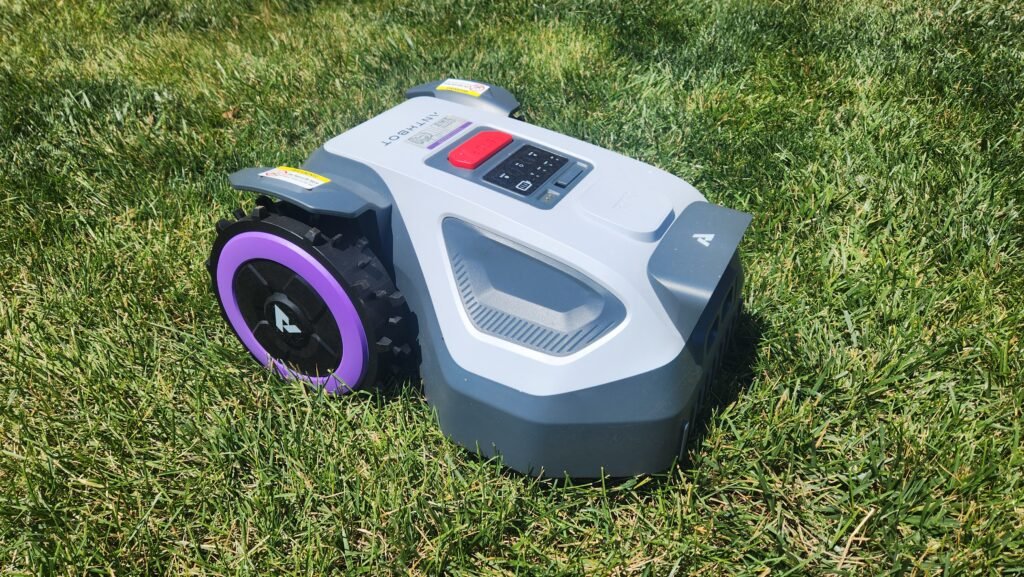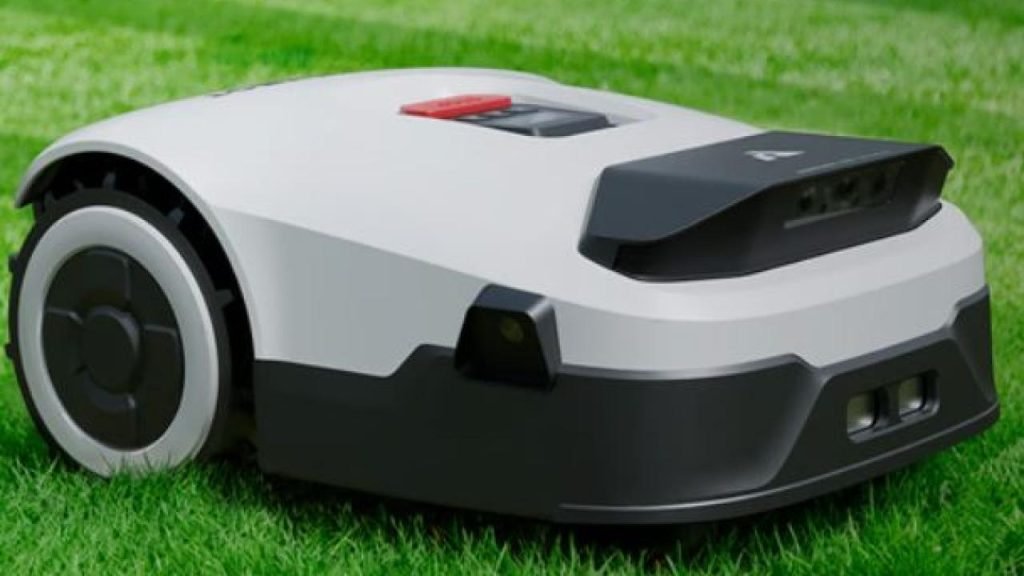

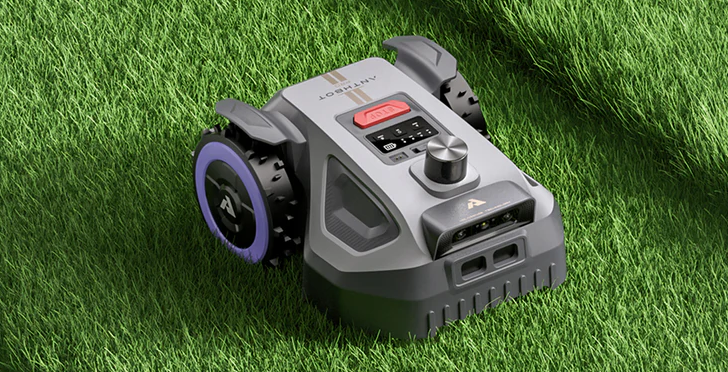
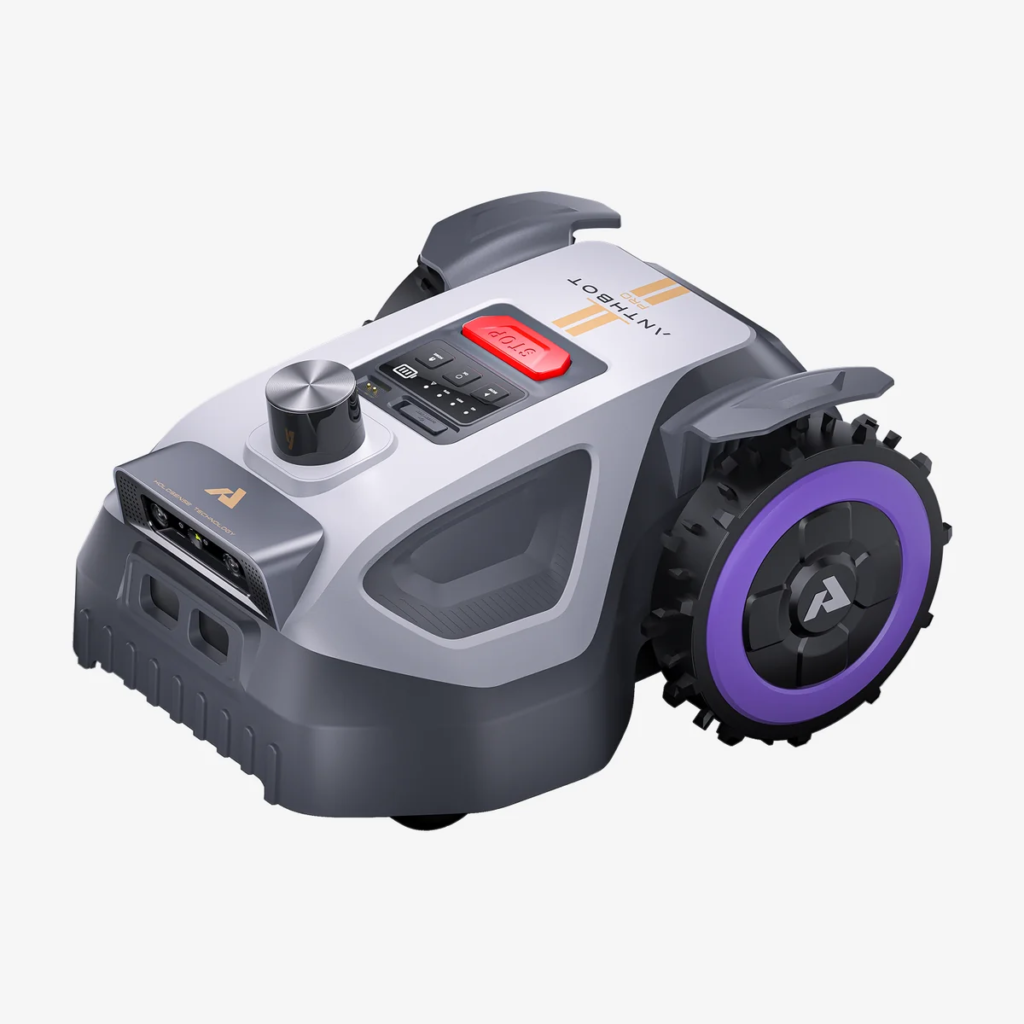
Robot mowers have spent the last few years fighting the same battle: how do you get rid of the buried boundary wire without making setup a nightmare or the price insane? Anthbot’s answer is the M9 Pro, the flagship of its new “Pro” line, and on paper it’s one of the most aggressively spec’d wire-free mowers we’ve seen at this price point. It’s currently available for pre-order in the EU (shipping from late July), priced at €1,299, and it’s positioned as the big-lawn sibling to the smaller M5 Pro.
We haven’t had wheels-on-grass time with this unit yet — it’s brand new and shipping just now, with zero customer reviews live as of this writing — so consider this a deep first-look breakdown of what Anthbot is promising, how it stacks up against the wire-free competition, and who should actually consider pre-ordering versus waiting for real-world data to come in.
The Big Pitch: HoloSense Quad-Fusion Positioning
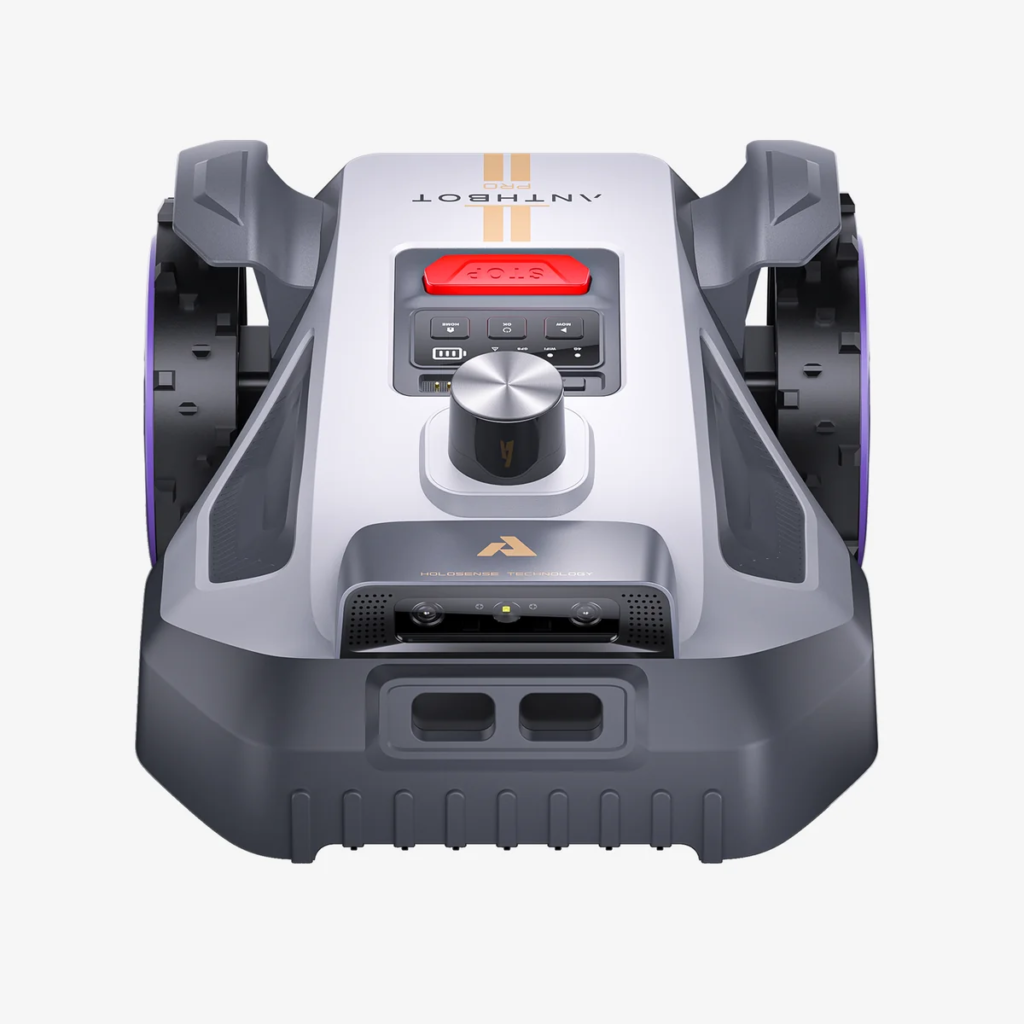
The headline feature of the M9 Pro is something Anthbot calls HoloSense Quad-Fusion Positioning — a navigation stack that combines four separate data sources:
- 360° LiDAR for continuous 3D mapping of the mower’s surroundings
- RTK (Real-Time Kinematic GPS) for centimeter-level satellite positioning
- NetRTK — a 4G-based alternative to RTK that skips the need for a physical base station
- Dual AI camera vision (two HDR cameras) for close-range obstacle detail
The idea is that these four systems cross-validate each other in real time, so if one loses its signal — GPS drops under tree cover, for instance — the others pick up the slack. Anthbot claims this combination gets positioning accuracy down to about 1 cm in most real-world conditions.
This matters because it’s the whole reason boundary wire and physical RTK stations become optional. Most “wire-free” mowers on the market today still lean almost entirely on GPS/RTK, which means they can struggle in exactly the spots most home lawns actually have: narrow side yards between houses, dense shade under mature trees, or tight corners where satellite signal gets flaky. By adding LiDAR into the mix as a constant 3D scanner, Anthbot is targeting those blind spots directly — the marketing specifically calls out narrow side-yard paths, deep tree shade, open stretches, indoor charging setups, poolside edges, and mowing under trampolines as scenarios it’s built to handle.
Whether that four-way fusion actually delivers 1 cm accuracy on a real lawn with real Wi-Fi dead zones remains to be seen. We’d treat that number as a lab claim until independent testing confirms it, but the underlying engineering logic — redundancy across totally different sensor types — is sound and is the same general direction premium robot vacuums went years ago for exactly the same blind-spot problem.
No Wire, No RTK Station, No Fuss
For anyone who’s installed a boundary-wire mower before, the pitch here is obvious: skip the trenching weekend entirely. Anthbot says the M9 Pro can go from box to mowing with one-tap auto-mapping and claims a full setup time of around 3 minutes — simple enough, they say, that older adults or kids could manage it.
The 4G connectivity is the piece that makes NetRTK possible without buying and mounting a separate RTK base station on your property. Anthbot is bundling one year of free NetRTK/4G service, after which it presumably converts to a subscription (worth confirming directly with Anthbot before you buy, since the product page doesn’t spell out post-trial pricing). That 4G module also handles remote app control, real-time GPS tracking, and security alerts.
Coverage, Cutting, and Terrain Handling
The M9 Pro is built for lawns up to 1,000 m² (roughly a quarter acre), running on a 5 Ah battery — double the coverage of the smaller M5 Pro, which tops out at 500 m² on a 2.5 Ah battery. If your lawn is on the smaller end, the M5 Pro is worth cross-shopping since it’s currently listed around €999.
A few cutting-specific details worth flagging for anyone comparing spec sheets:
- Cutting width: 20 cm blade disc, which Anthbot says produces efficient U-shaped mowing paths for a more even, gapless finish than a simple back-and-forth pattern.
- Cutting height range: 3–7 cm, adjustable directly from the Anthbot app — useful if you’re managing a lawn with mixed grass types or want to raise the deck during a summer dry spell.
- Slope handling: up to 45% grade (24°), aided by larger rear wheels and a traction control system (TCS) that Anthbot says corrects for wheel spin, understeer, and oversteer on hills.
- Obstacle clearance: can climb over obstacles up to 3 cm tall, and the AI vision system is trained to recognize more than 1,000 distinct obstacle types.
- Multi-zone scheduling: the app can manage up to 50 mowing zones, automatically adjusting the schedule around local sunrise/sunset times and pulling in rain sensor data to skip wet-weather cuts.
That slope rating in particular stands out — 45% is a genuinely steep grade, well beyond what a lot of wire-free competitors are rated for, and it’s the kind of spec that will matter a lot to anyone with a sloped or terraced yard where robot mowers have traditionally struggled or flat-out refused to operate.
Edge Cutting: The Perpetual Robot Mower Weak Spot
Every robot mower eventually runs into the same complaint: a stripe of uncut grass right along the edge, because the cutting disc sits inboard of the wheels. Anthbot’s answer here is a feature it calls EdgeWiz, which is supposed to detect the boundary between lawn and hardscaping (patios, walkways, driveways) and hug that line precisely enough to eliminate manual trim work. If it performs as advertised, that’s a meaningful quality-of-life upgrade — trimming is the one job robot mowers rarely fully replace, and it’s worth watching for early buyer feedback on how well EdgeWiz actually handles curved or irregular bed lines versus straight concrete edges.
Quiet Operation and Everyday Livability
A few details that matter more for daily life than for the spec sheet:
- Noise: rated at ≤58 dB, which Anthbot pitches as weekend-friendly — quiet enough not to be a neighbor complaint magnet, though “lab-measured” noise ratings often run a few decibels below real-world numbers once you factor in uneven terrain or a dull blade.
- Weatherproofing: IPX6-rated, so it’s built to handle rain and hose-down cleaning (though Anthbot explicitly warns against using a pressure washer on it).
- Rain sensor: automatically sends the mower back to its charging dock if rain starts mid-cycle.
- Emergency stop and anti-theft tracking: the app sends an alert if the mower crosses its virtual boundary, which doubles as basic theft protection given these units live outdoors full-time.
- Compact footprint: Anthbot emphasizes the M9 Pro’s ability to navigate narrow side-yard paths and tight corners, plus indoor charging placement if you don’t want the dock sitting outside year-round.
Price and Where It Sits in the Lineup
At €1,299, the M9 Pro sits above the standard M9 (currently discounted to around €719–€849) and above the M5 Pro (€999), positioning it as the top-tier “wire-free, sensor-fusion” option in Anthbot’s M-series. That’s a real premium over wire-based competitors in the same coverage class, but the trade is the entire wire-installation process and the RTK base station hardware — both of which add real cost and labor on cheaper systems once you account for them.
Worth noting: this is a pre-order product as of publishing, with shipping estimated to begin July 26 and no customer reviews live yet. If you’re mowing-season-sensitive, factor that lead time into your decision — you may be waiting a few weeks for delivery, and you’ll be an early adopter on hardware and firmware that hasn’t accumulated a track record yet.
Who Should Consider the M9 Pro (and Who Should Wait)
Good fit if:
- Your lawn is up to 1,000 m² and has genuinely tricky navigation spots — deep tree shade, narrow side yards, or slopes that have made you skeptical of robot mowers in the past.
- You specifically don’t want to deal with trenching a boundary wire or mounting a dedicated RTK base station.
- You’re comfortable being an early adopter on a newly launched product line.
Worth waiting on if:
- Your lawn is small, open, and flat — a cheaper wire-based mower or even the standard M9 will likely do the job for meaningfully less money.
- You want to see independent, hands-on reviews and real owner feedback on EdgeWiz accuracy and NetRTK reliability before committing over a grand to unproven hardware.
- You’re not sure what the NetRTK/4G service costs after the included first year — that’s a real ongoing cost question Anthbot hasn’t fully answered on the product page.
The Bottom Line
The Anthbot M9 Pro is making one of the more technically ambitious pitches in the wire-free robot mower space right now: stack LiDAR, RTK, NetRTK, and dual AI cameras together so no single point of failure takes down your mowing schedule. On paper, that’s a genuinely smart way to solve the blind-spot and signal-loss problems that have plagued GPS-only wire-free mowers. The slope rating, edge-cutting feature, and 3-minute setup claim are all compelling if they hold up in the yard rather than just in Anthbot’s lab.
The catch is that “if they hold up” is still an open question — this is a pre-order product without a single verified review at time of writing. If you’ve got the patience to wait for early-adopter feedback to roll in, that’s the safer play. If you’ve got a genuinely difficult lawn that’s frustrated every robot mower you’ve tried, the M9 Pro might be worth being one of the first to find out.