

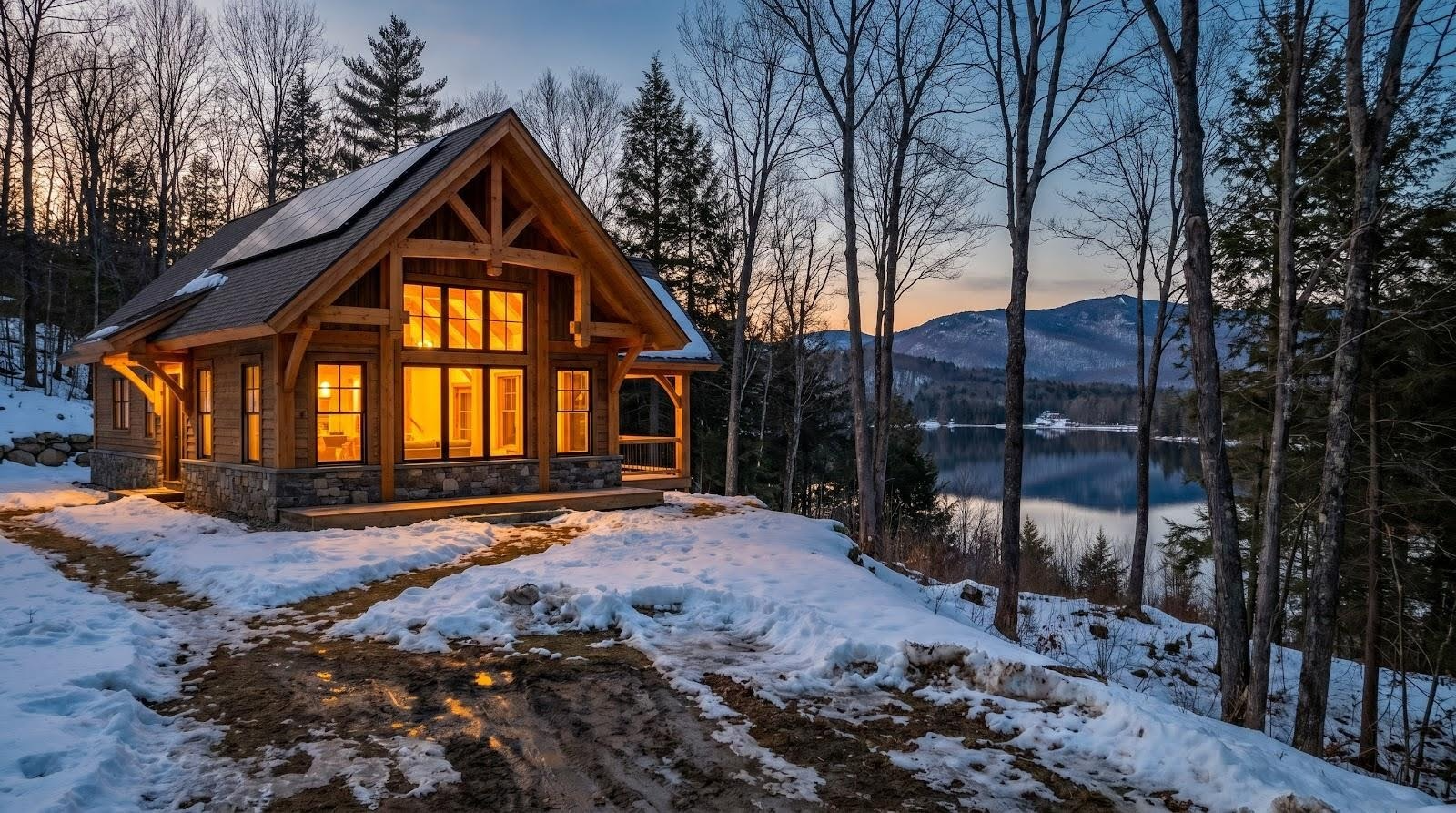
Vermont’s ridgelines and still lakes beg for homes as enduring as the view. Timber frames deliver that permanence, yet code now matters as much as craft. Since July 1, 2024, every new house must meet stricter insulation and air-sealing targets under the [Residential Building Energy Standards]—rules that demand smarter shells, not just pretty posts. We compared HERS scores, price sheets, and homeowner reviews to crown the seven builders that blend beauty, performance, and transparency. Follow our trail map to choose the partner whose frame will shrug off February blizzards without flinching.
How we selected & ranked Vermont timber-frame builders
You deserve a shortlist built on evidence, not hype. Before looking at glossy photos, we created a scoring model around five performance pillars that matter in snow country: energy efficiency, craftsmanship, cost transparency, customer satisfaction, and design support.
Each pillar carries real weight. Efficiency and craftsmanship sit at 25 percent apiece because a Vermont home must stay warm and stand strong for decades. Cost clarity follows at 20 percent—nobody likes budget creep. We round things out with customer happiness and design flexibility at 15 percent each.
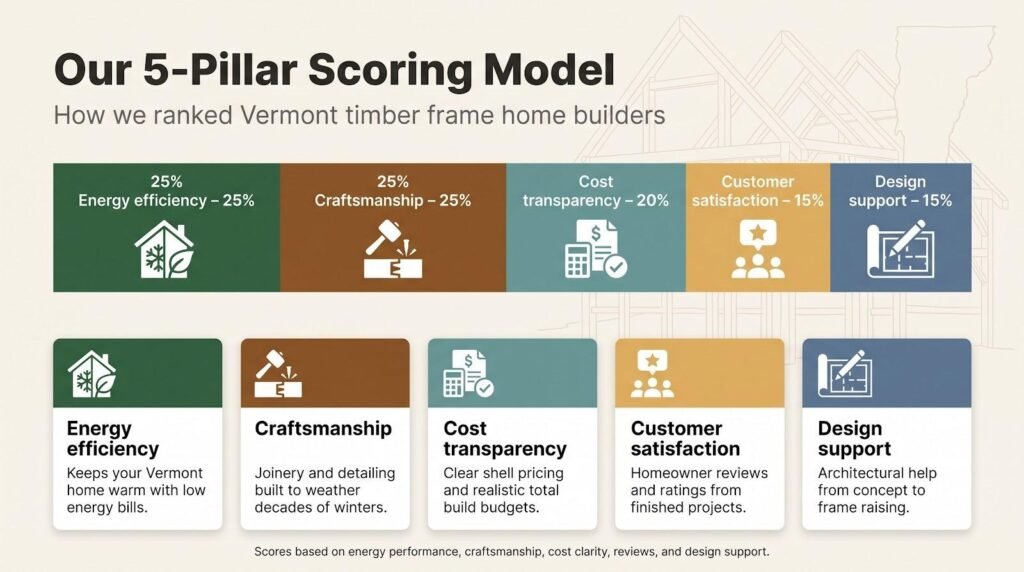
For every builder we gathered hard data: HERS scores, SIP specs, pricing sheets, and public reviews. We converted those findings into ten-point scores, applied the weights, and produced one composite number. When two firms tied, we used differentiators such as niche expertise or project scale to break the deadlock.
Transparency mattered. For example, Vermont Frames states on its site that a frame-and-panel shell usually represents only a quarter to a third of total build cost, and our model rewards that honesty.
The result is a ranking you can trust—one that highlights builders who craft gorgeous joinery, meet the 2024 energy code, and earn praise from homeowners who have already weathered a few winters inside their timber sanctuaries.
Now that you know the rules, let’s see who plays the game best.
Side-by-side snapshot: how the top builders stack up
Before we dive into individual profiles, let’s pause for a quick overview. Numbers never tell the full story, but they reveal patterns you should notice. The table below condenses our weighted scores into a single glance. Higher numbers signal stronger performance on that pillar.
| Builder | Sustainability | Craftsmanship | Cost clarity | Reviews | Design support | Overall |
| Hamill Creek Timber Homes | 9 | 9 | 8 | 9 | 9 | 8.8 |
| Bensonwood | 10 | 9 | 6 | 9 | 9 | 8.6 |
| Vermont Frames | 8 | 8 | 9 | 10 | 7 | 8.4 |
| Yankee Barn Homes | 9 | 8 | 7 | 9 | 8 | 8.1 |
| Davis Frame Company | 8 | 8 | 8 | 9 | 8 | 8.0 |
| Vermont Timber Works | 7 | 9 | 7 | 9 | 6 | 7.8 |
| TimberHomes Vermont | 10 | 8 | 7 | 9 | 9 | 7.7 |
A few insights stand out.
Bensonwood earns a perfect ten in sustainability, reflecting its Passive House level shells. Vermont Frames tops the cost clarity column by publishing real numbers, while Vermont Timber Works leads craftsmanship with joinery you can spot across the room.
Consider which columns matter most to you. If low energy bills guide your choice, focus on the sustainability scores. If budget certainty keeps you awake, cost clarity should carry more weight. Use this grid as a compass as we head into the detailed reviews.
Ready? Let’s meet the builders one by one.
1. Hamill Creek Timber Homes: global craft, Vermont-ready performance
Picture a frame so precisely cut that every mortise and tenon clicks together on site like a full-scale puzzle. That’s Hamill Creek’s signature. The Canadian team test-assembles each structure in its British Columbia shop, labels every beam, and then ships the kit east. Before a truck ever leaves the yard, the crew dry fits every joint, documents the frame, and wraps the timbers for the long haul, a shipping protocol detailed in Hamill Creek’s Vermont Timber Frame Builders guide that reassures Vermont clients about timing and condition. When the labeled package finally rumbles up your mountain road, the crew unloads components that raise fast and fit tight, which is crucial when spring mud season is only weeks away.
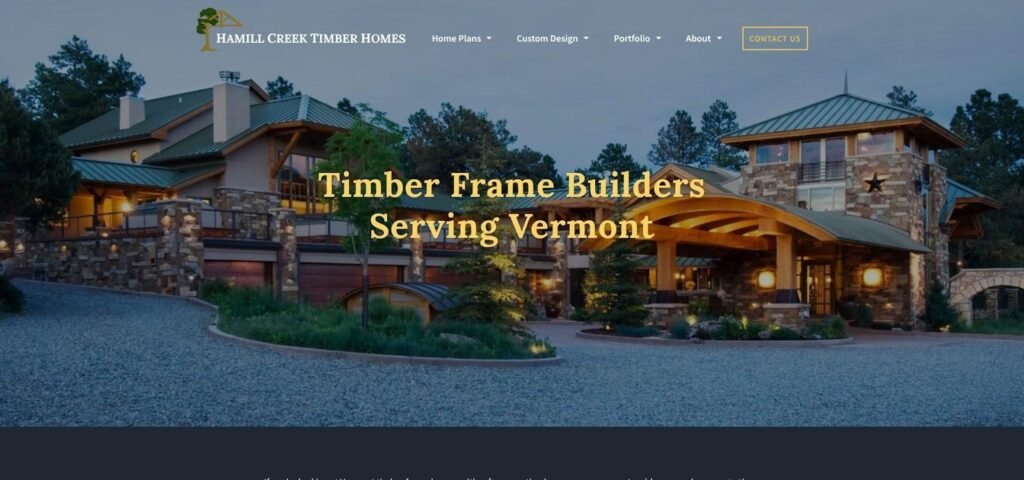
Hamill Creek Timber Homes Vermont timber frame builder webpage screenshot
Quality shows in the wood itself. Hamill Creek favors dense, kiln-dried Douglas fir certified by the Forest Stewardship Council. The timbers arrive with structural insulated panels that push wall R-values well beyond the 2024 code. Add triple-pane glass and you are flirting with net-zero.
Design help is hands-on. Company architects join video calls, swap 3-D models in real time, and fine-tune everything from roof pitch to window mullions. If you want a glass gable facing Lake Champlain or a curved brace that echoes ski-slope lines, they will model it, engineer it, and cut it on their CNC equipment.
Cost sits in the premium tier, yet transparency softens the blow. Hamill Creek fixes the shell price early—timbers, panels, steel, hardware, and delivery included. You hire a local general contractor for foundation and finishes while a Hamill Creek coordinator stays on call until the last peg is seated.
Why place them first? They deliver museum-grade joinery, near-Passive House shells, and a smooth build sequence that keeps surprises off the job site. If you want a mountainside retreat that raises once, lasts generations, and feels like art, start your research here.
2. Bensonwood: high-tech timber for net-zero ambitions
Step into a Bensonwood home and the first thing you notice is silence. Thick wood-fiber panels and triple-glazed glass hush wind, rain, even kids’ footsteps on the loft above. That acoustic calm is a by-product of engineering aimed squarely at energy performance.
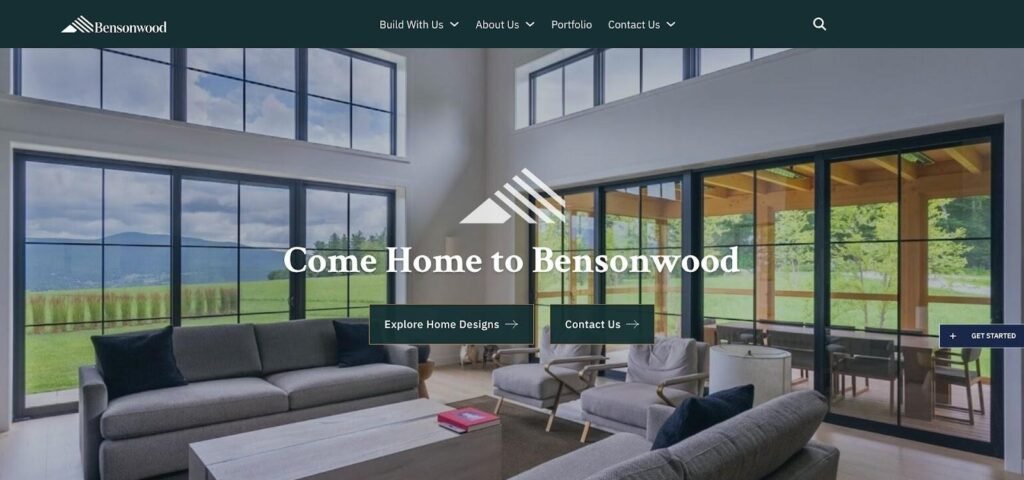
Bensonwood high-tech net-zero timber home builder website screenshot
Everything starts inside Bensonwood’s climate-controlled factory in Walpole, New Hampshire. Robots and master carpenters work side by side, CNC-cutting timbers and sealing wall “cassettes” that already contain insulation, wiring chases, and window bucks. When the labeled pieces reach your Vermont site, crews crane them into place, and a weather-tight shell often stands in less than two weeks. Fast lock-up means the frame never sits soaking during mud season.
Performance numbers back the craft. Standard walls reach about R-40, roofs climb past R-60, and blower-door tests record air-tightness most builders only imagine. Add a heat-recovery ventilator and rooftop solar and you get a house that sips energy while snow piles high outside.
Design wise, Bensonwood balances modern minimalism with New England charm. Exposed beams anchor wide open rooms, yet details stay crisp, with slim window grids and clean white ship-lap between rafters. Start from a blank slate or tweak one of their preset models; either way, 3-D modeling sessions let you walk through your future living room long before the saws start.
Sticker price? Premium. Bensonwood states that turnkey costs sit north of four hundred dollars per square foot. The math changes when you add decades of low utility bills, precise fit, and resale value tied to a recognized industry pioneer. If you want a mountain lodge that keeps energy costs low and raises in record time, Bensonwood earns its silver medal.
3. Vermont Frames: home-grown craft at a neighborly price
Vermont Frames Starksboro timber frame builder website screenshot
Drive south on Route 116 toward Starksboro and you’ll spot a low-slung shop that has cut timbers since 1976. Inside, carpenters still lay out mortise-and-tenon joints with pencil and square while a CNC saw hums in the background. That blend of hand skill and precision defines their work.
Local knowledge is their secret sauce. These builders grew up stacking hay in post-and-beam barns and understand freeze-thaw cycles instinctively. You see it in details such as pegged knee braces sized for 90-pound snow loads and roof panels craned into place before October rain settles in.
Money talks feel refreshingly candid. Vermont Frames publishes ballpark numbers online and reminds clients that the timber frame plus SIP enclosure is usually one quarter to one third of total build cost. That clarity helps you set a realistic budget and keeps surprises off the spreadsheet.
Customer praise backs the numbers. Homeowners rave about crews who show up early, raise a frame in days, and leave sites cleaner than they found them. A sister company mills the SIPs next door, adding speed and quality control.
Choose Vermont Frames when you want a true Vermont team that talks straight about costs and slips your frame into the landscape as if it has always belonged there.
4. Yankee Barn Homes: barn-style warmth, modern envelope
Yankee Barn’s magic trick is simple, capture the soul of a 19th-century barn and wrap it in 21st-century performance. Trademark designs lean into soaring hammer-beam trusses, hay-loft windows, and cupolas that feel at home overlooking Lake Willoughby or a Killington ski run.
Look past the rustic shell and you will find high-density True Wall and True Roof panels preloaded with insulation and windows. These panels bolt to numbered Douglas-fir posts, allowing the crew to lock the house up in about ten days, quick enough to dodge an April snow squall.
Because base models start as CAD files, customization is painless. Want to widen the great-room gable for a bigger view or add a mudroom wing for ski gear? A designer tweaks the file, reruns the structural math, and feeds the update to the factory saws.
Price lands in the upper-mid range, not as steep as tech-heavy outfits yet above local stick framing. What you pay for is character. Clients rave about cupolas that glow at dusk and vaulted spaces that turn family gatherings into storybook moments.
If you picture a red-barn silhouette against fresh snow and still demand airtight comfort, Yankee Barn delivers that postcard and makes it energy smart.
5. Davis Frame Company: versatility meets panelized speed
Davis Frame sits just across the Connecticut River in Claremont, yet its work dots Vermont from tiny off-grid cabins in the Northeast Kingdom to 4,000-square-foot hybrid lodges near Stowe. Flexibility is the company’s north star.
You choose the structural recipe. Go full timber for cathedral drama, mix posts with conventional framing to stretch dollars, or skip heavy timbers and let Davis supply a high-efficiency panelized shell. All three options roll out of the same modern plant, so tolerances stay tight no matter the style.
That plant also saves time. Wall and roof panels leave the line with sheathing, insulation, and window cut-outs ready. On site, crews bolt the pieces together like an oversized IKEA set. Weather-tight in about two weeks means fewer delays and a cleaner schedule for your general contractor.
Design support earns praise. Homeowners describe a collaborative process where architects and engineers tweak spans or window layouts until cost, aesthetics, and structure align. One client put it simply, “We loved the way Jeff Davis and his staff took our hand drawn house plans and turned them into a home.”
Price lands in the middle lane. Choose a hybrid frame to keep wow factors in public rooms while trimming timber spend, or select panel-only to drive cost even lower. Either way, Davis Frame’s factory polish and seasoned project managers keep change orders rare.
If you want options and a crisp production timeline, Davis Frame hands you the menu and the stopwatch, then delivers on budget and on schedule.
6. Vermont Timber Works: signature frames for one-of-a-kind spaces
Some builders sell packages; Vermont Timber Works creates sculpture you can live in. Step inside one of their frames and you will notice curved braces, hidden steel plates, or a forty-foot hammer-beam truss that feels lifted from a cathedral. Every project leaves the Springfield shop custom-drawn, hand-cut, and trial-fit before heading to your site.
That obsession with form never forgets function. In-house engineers size each timber for local snow loads and wind exposure, then bury reinforcement inside the wood so the finished joint looks centuries old. The result is a frame that passes modern code yet reads like pure tradition.
Because VTW focuses on the skeleton, you are free to pair it with any enclosure system. Many clients bring in SIP vendors or natural-build teams for straw-bale infill. VTW simply coordinates bolt patterns and overhangs so all parts marry cleanly. This bespoke approach invites creativity, though it adds a bit more planning on your end.
Pricing runs higher than kit suppliers, but you are commissioning functional art. Homeowners describe framing day like a celebration: friends gather, a crane lifts timbers skyward, and by sundown a cathedral of wood stands where only footings sat that morning. That memory, plus a jaw-dropping great room, is value you will not find in a spreadsheet.
If your dream sketch includes sweeping spans, statement trusses, or woodwork that stops visitors mid-sentence, Vermont Timber Works is the partner who says “yes, we can build that” and then proves it.
7. TimberHomes Vermont: local timbers, cooperative spirit
TimberHomes Vermont builds like a neighbor helping raise a barn because the crew really are neighbors; they co-own the company as a worker cooperative. That shared stake shows in every peg they tap home. Projects stay deliberately small, usually under two thousand square feet, and each one starts with logs trucked from forests within a short drive of the Vershire shop. Your frame may have grown on the same ridgeline you will admire from the porch.
Sustainability here is action, not marketing. The team mills regional hemlock and pine, reuses off-cuts for heat, and prefers cellulose or wool insulation instead of foam. Clients who want natural walls can choose straw bale or clay plaster, and TimberHomes simply adjusts post spacing to suit.
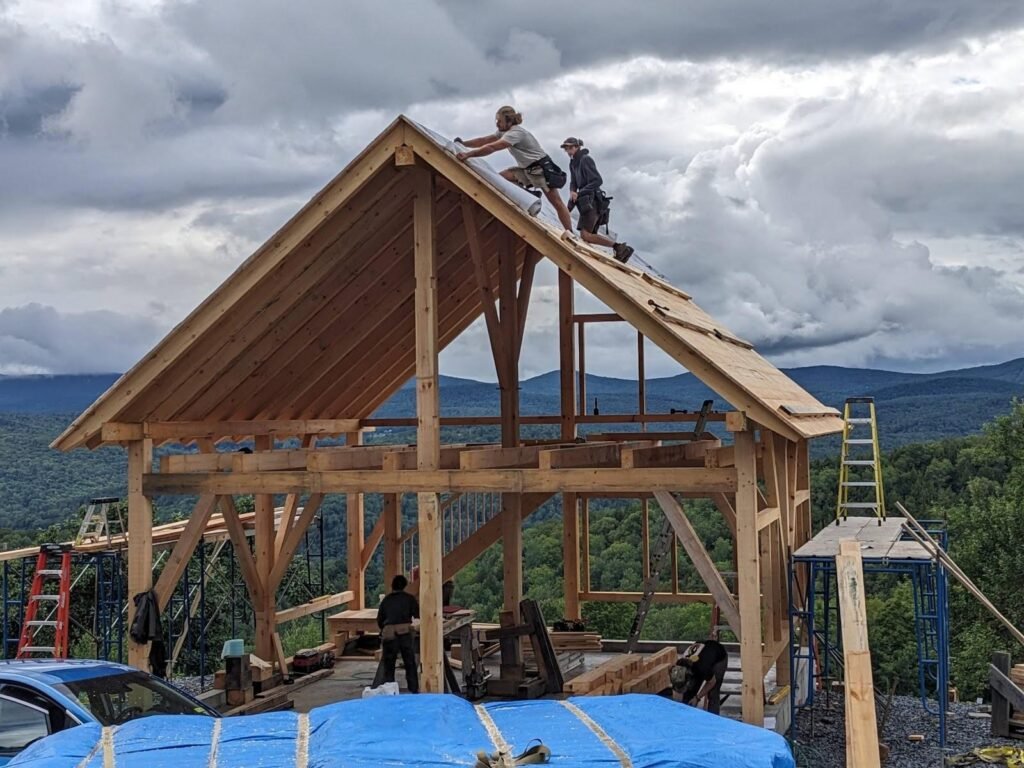
The build feels more community event than contract. Homeowners often join the raising, driving a few pegs while friends cheer and share sandwiches. The pace is human but not slow; frames rise efficiently, though lead times stretch because the coop books only a handful of projects each year.
TimberHomes Vermont cooperative local timber frame raising photo
Cost sits mid-pack, roughly on par with Vermont Frames once finishes are included, yet the value tilts toward intangibles: wood with a known provenance, craftsmen who own the outcome, and a carbon footprint your conscience accepts.
Choose TimberHomes Vermont if you want a modest retreat that feels rooted in land and community. You will not get glossy brochures or endless plan catalogs, but you will get a house that tells a Vermont story, one locally sawn beam at a time.
Choosing the right timber-frame partner for your Vermont build
We just toured seven standout companies, but the right fit depends on what you value most. Let’s match common homeowner priorities with the builders that serve them best.
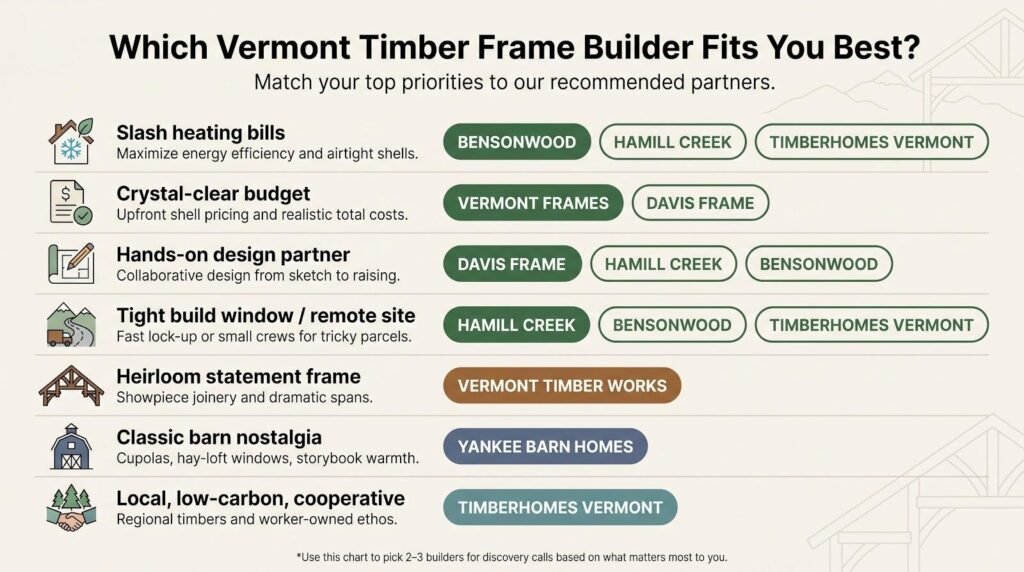
Start with energy goals. If you want a home that nearly erases heating bills, focus on the top of our sustainability column. Builders such as Bensonwood routinely exceed Vermont’s Residential Building Energy Standards, which raised insulation and air-sealing targets on July 1, 2024. Factory-sealed shells make code compliance a given.
Next, weigh budget transparency. Vermont Frames posts real numbers online and reminds clients that the timber frame plus SIP enclosure is usually one quarter to one third of total build cost. That clarity trims anxiety and helps you plan finishes without guessing. If open pricing sets your mind at ease, keep them high on the list.
Crave a collaborative design journey? Look at recent reviews. Davis Frame earns 4.6 stars on Houzz, and one homeowner wrote, “We loved the way Jeff Davis and his staff took our hand-drawn house plans and turned them into a home.” Comments like that signal a partner who listens before cutting wood.
Location matters as well. Mountain parcels often demand quick lock-up between mud season and first frost, so prefab specialists like Hamill Creek and Bensonwood shine. Remote lake lots with narrow roads may benefit from smaller local crews such as TimberHomes Vermont that can stage materials in tight spaces.
Finally, consider intangibles. Vermont Timber Works offers heirloom artistry, Yankee Barn delivers nostalgia inside a smart envelope, and TimberHomes Vermont provides cooperative ownership and lumber you can trace to a nearby hillside. None of those perks show up on a spreadsheet, yet they shape how your home feels every day.
Our advice: book discovery calls with your top two or three choices. Share site photos, budget targets, and must-have design ideas early. How each company responds—how quickly, how clearly, how creatively—will tell you as much as any score in our chart. When the right partner clicks, you will feel it.
Then, when ground thaws and the crane lifts that first beam into the sky, you will know you chose a team ready to turn Vermont’s raw beauty into a timber-framed reality built to last.