

The robot mower market is no longer a playground for just a handful of established names. Over the past couple of years, a new wave of brands has arrived with fresh technology, smarter navigation, and genuinely exciting engineering — some borrowed from industrial robotics, some rooted in the smart home ecosystem, and some built from the ground up with real-world lawns in mind.
If you’ve been watching the space and wondering whether any of the newer players are worth your attention (and your money), the answer is a resounding yes — for the right buyer. Here are four newer robot mower brands worth putting on your radar, and what makes each one stand out.
1. MOVA — The LiDAR Powerhouse From the Dreame Ecosystem
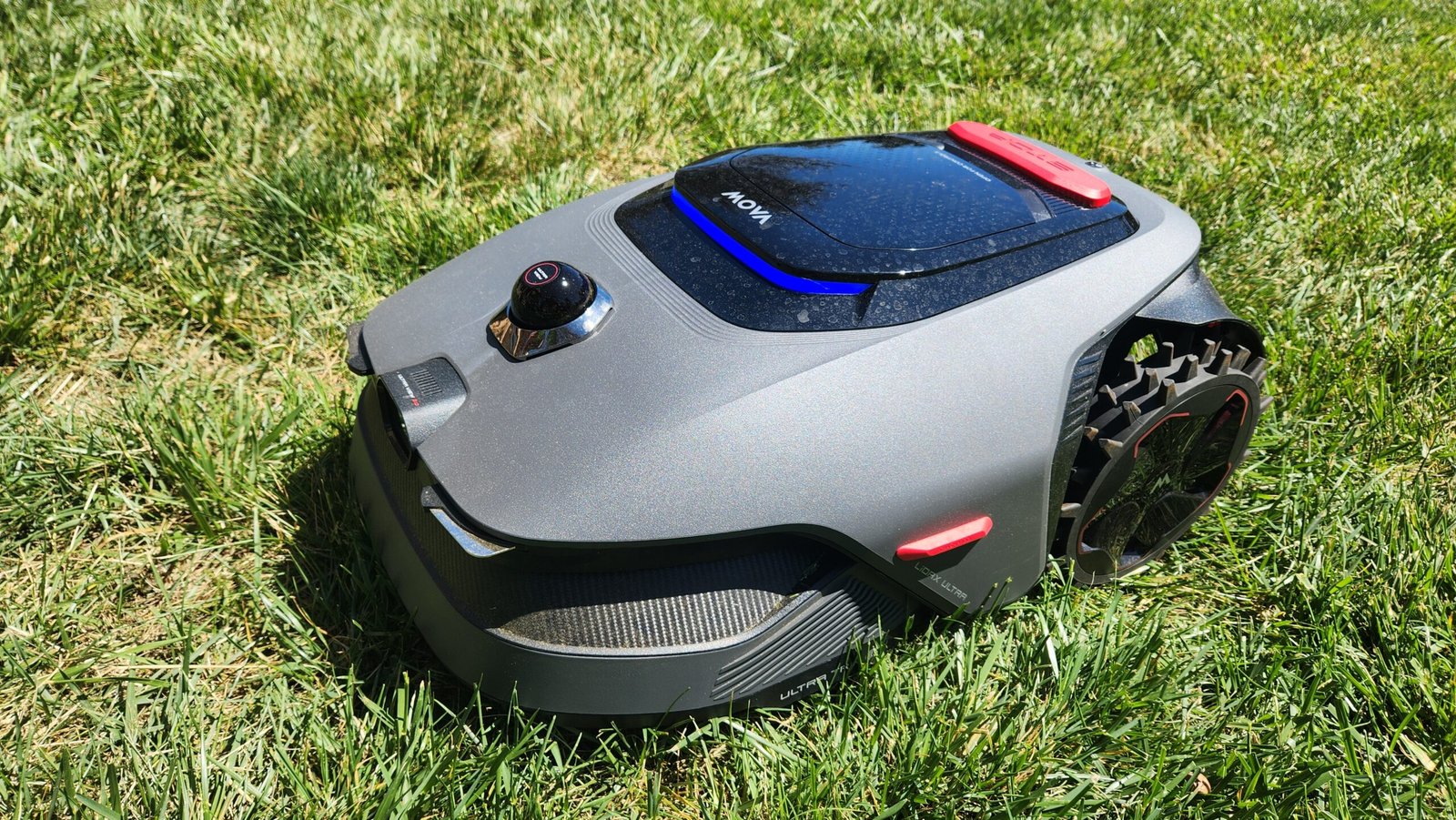
If you’ve been paying attention to the robot vacuum world, you’ve likely heard of Dreame. MOVA is the outdoor arm of that same ecosystem, and it has been making aggressive moves in the robot mower market since its debut at IFA in Germany in 2024.
What makes MOVA interesting is its early and committed investment in LiDAR technology. While many brands were still relying on basic GPS or boundary wires when MOVA launched, the company paired its mowers with Hesai 3D LiDAR sensors — the same kind of compact, high-precision units used in advanced robotics and autonomous vehicles. The result is a mower that can navigate in the dark, handle strong sunlight glare, and map a yard with centimeter-level accuracy without needing any perimeter wire or RTK ground station.
MOVA’s lineup has grown quickly. The MOVA 600 and MOVA 1000 debuted to enthusiastic early adopters in Europe, and the brand then pushed into North America and Southeast Asia through the end of 2024. By early 2026, MOVA had been recognized by Frost & Sullivan as the global number-one LiDAR-powered robot mower brand by sales volume for 2025 — a remarkable achievement for a brand that barely existed two years earlier.
At CES 2026, MOVA unveiled the LiDAX Ultra Series, which takes the technology further still. These mowers combine 360-degree 3D LiDAR with AI vision intelligence, designed to handle mid-to-large lawns with complex layouts. The LiDAX Ultra 1000 starts at around $1,299 in the US, with the LiDAX Ultra 2000 coming in at $1,799. For larger or more demanding properties, MOVA also introduced the LiDAX Ultra AWD 3000 — a model with all-wheel drive, a hybrid LiDAR-vision system, and a 1080p HDR camera capable of spotting obstacles up to 230 feet away, priced around $3,000.
MOVA also launched the ViAX Series for smaller gardens, leaning on what the company calls UltraEyes AI dual-vision technology — a more affordable entry point that still delivers wire-free convenience and smart navigation.
Who should consider MOVA? Homeowners who want proven, market-tested LiDAR navigation at a reasonable price point, especially those who want to stay within a smart home ecosystem. MOVA’s rapid market growth and its backing from the Dreame organization mean you’re getting strong post-purchase support, frequent software updates, and a product roadmap that’s clearly well-funded. The brand ships with a 3-year warranty policy — which is meaningful in a category where you’re spending over a thousand dollars on outdoor electronics.
2. ANTHBOT — The Wire-Free Overachiever for Real-World Yards
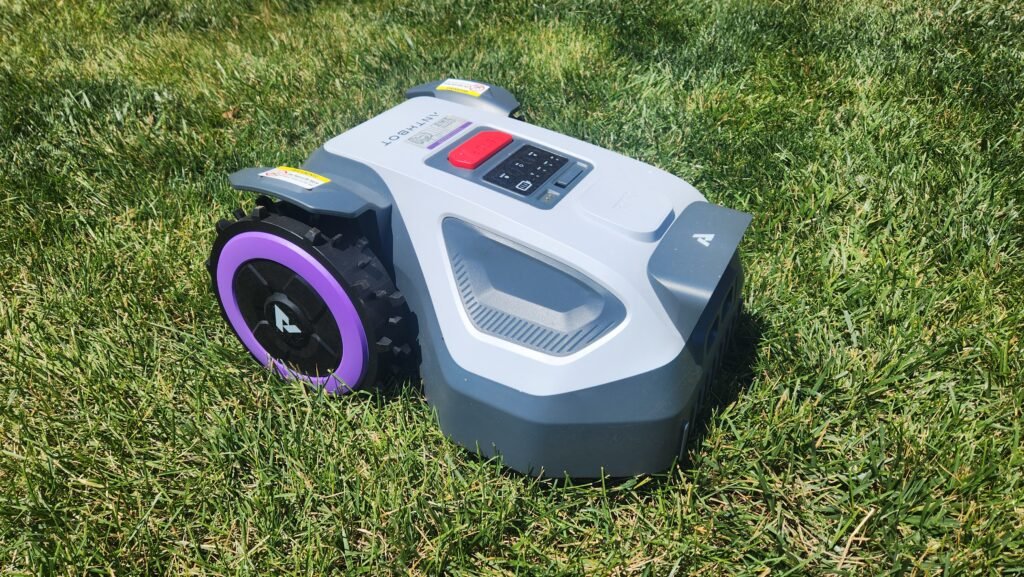
ANTHBOT might be the sleeper hit of the new robot mower generation. The brand doesn’t have the name recognition of some of its peers, but among users who have actually deployed one of its mowers, word-of-mouth has been remarkably strong.
The brand’s flagship wire-free lineup centers on the Genie series — available in the Genie 600 (suited for up to 0.22 acres), the Genie 1000 (up to 0.49 acres), and the Genie 3000 (up to 0.89 acres). All three use a full-band RTK navigation system paired with a four-eye visual positioning setup, giving the mower a redundant approach to knowing exactly where it is — even under tree canopy, near buildings, or in areas where satellite signal gets degraded. The wire-free setup means there’s no perimeter cable to bury, no stakes to install, and no wire breaks to diagnose later.
Setup is impressively fast. The auto-mapping feature creates virtual boundaries without manual walking — users report getting up and running in 10 to 15 minutes. The companion app lets you create up to 30 mowing zones, set individual schedules for each one, define no-go areas, adjust cutting height, and monitor the mower’s location and battery in real time from anywhere. A rain sensor detects moisture and sends the mower back to its base automatically, and the unit carries an IPX6 waterproof rating for additional peace of mind.
One of ANTHBOT’s most notable strengths is its approach to customer engagement. Users consistently flag the company’s responsiveness on support channels, including a dedicated presence on Facebook where questions are reportedly answered quickly by product specialists. For a newer brand selling an expensive product, that kind of post-sale communication matters enormously.
ANTHBOT also recently released the M9, a more compact wire-free mower aimed at smaller yards — up to a quarter acre — that launched to positive reviews for its “Drop & Mow” simplicity. Reviewers praised its ability to handle uneven terrain, navigate around trees and tight corners, and self-recover when it got into tricky spots, thanks to its all-terrain tires and AI depth recognition cameras.
Who should consider ANTHBOT? Homeowners who want reliable wire-free performance without paying flagship prices, and who appreciate a brand that listens to user feedback and pushes software updates regularly. ANTHBOT hits a practical sweet spot: the tech is legitimately impressive, the setup is genuinely easy, and the support experience tends to exceed expectations. If you’ve been hesitant about robot mowers because of complicated installation or poor customer service stories with other brands, ANTHBOT is a compelling alternative.
3. LawnSense — The Precision-First Challenger on Kickstarter
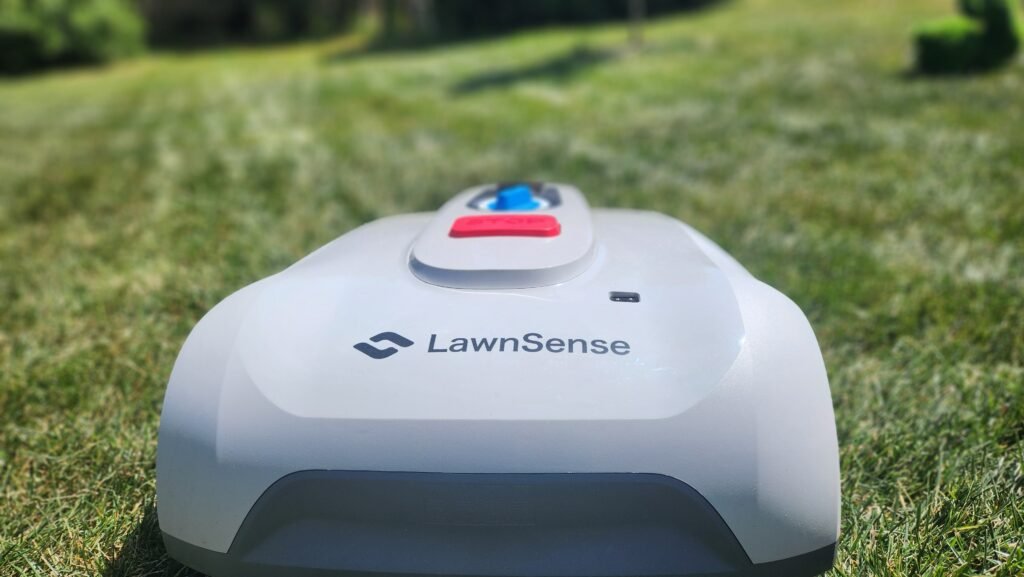
Not every great robot mower brand arrives with a splashy trade show debut. Some of the most thoughtfully engineered entrants come straight from the crowdfunding world, built by teams that care deeply about solving real problems. LawnSense is exactly that kind of brand — and its debut product, the Tango, is currently live on Kickstarter with a spec sheet that deserves serious attention.
The Tango’s core technology is built around what LawnSense calls NexusNav™ — a dual-layer positioning system that pairs RTK (Real-Time Kinematic) satellite navigation with AI-assisted vision cameras. This hybrid approach is worth understanding, because LawnSense makes a deliberate and well-reasoned case for RTK over LiDAR on larger lawns. RTK uses satellite signals to deliver absolute coordinates across the entire mowing area, whereas LiDAR and vision-only systems rely on identifying distinct relative objects to calculate position — an approach that can break down on large open lawns where there simply aren’t enough distinct features to lock onto. The Tango’s AI vision cameras then act as a backup layer, taking over navigation when satellite signals are weak (under trees, near buildings, in tight spots), ensuring stable performance regardless of conditions.
The cutting system is notably strong for a Kickstarter product. The Tango uses a dual-disc setup with a 35cm (13.78-inch) cutting width — significantly wider than the 18–22cm single-disc designs common in many robot mowers at this price point. That wider swath means fewer passes to cover the same area, and noticeably faster mowing times on medium to large properties. Cutting height is adjustable from 20mm to 70mm, giving you flexibility from a tight manicured finish to a longer, more relaxed cut. The mower also offers three distinct mowing patterns — Zigzag, Grid, and Diamond — which can be applied globally or per-zone. That last detail is a nice touch: the ability to run a diamond pattern on the front lawn and a grid on the back isn’t something many mowers in this class offer.
The Tango comes in three models to suit different property sizes. The Tango 2000 covers up to 0.5 acres with 20 supported zones, running on an 18V 5Ah battery with a 90-minute charge time and one year of free 4G cellular connectivity. The Tango 4000 steps up to 1 acre and 40 zones, with a faster 50-minute charge and two years of free cellular included. The flagship Tango 6000 handles up to 1.5 acres across 60 zones, upgrades to an 18V 10Ah battery (80-minute charge), and includes three years of free 4G. All three models share the same RTK + Vision navigation, Vision + Collision obstacle avoidance, IPX6 waterproof rating, 45% (24°) max slope capability, and a quiet 60 dB(A) noise level — connectivity across the range includes Bluetooth, Wi-Fi, and 4G cellular.
The inclusion of multi-year free cellular on all models is worth highlighting. 4G connectivity means the mower can be monitored and controlled remotely from anywhere, and LawnSense baking that into the purchase price rather than hiding it behind a subscription is a consumer-friendly move that not all brands in this space make.
You can back the LawnSense Tango directly at the LawnSense Kickstarter page.
Who should consider LawnSense? Homeowners with medium to large lawns who want genuine RTK precision, a wide cutting width, and flexible zone and pattern control — at Kickstarter pricing that beats what retail will likely look like. The Tango’s spec sheet is competitive with mowers costing significantly more, and the NexusNav™ argument for RTK over LiDAR on open lawns is technically sound. As with any crowdfunded product, it’s worth reviewing the full campaign, timeline, and team background before committing — but based on what LawnSense has laid out, the Tango is one of the more technically credible Kickstarter mowers we’ve seen come to market.
4. GOKO — Industrial-Grade Engineering, Brought to Your Backyard
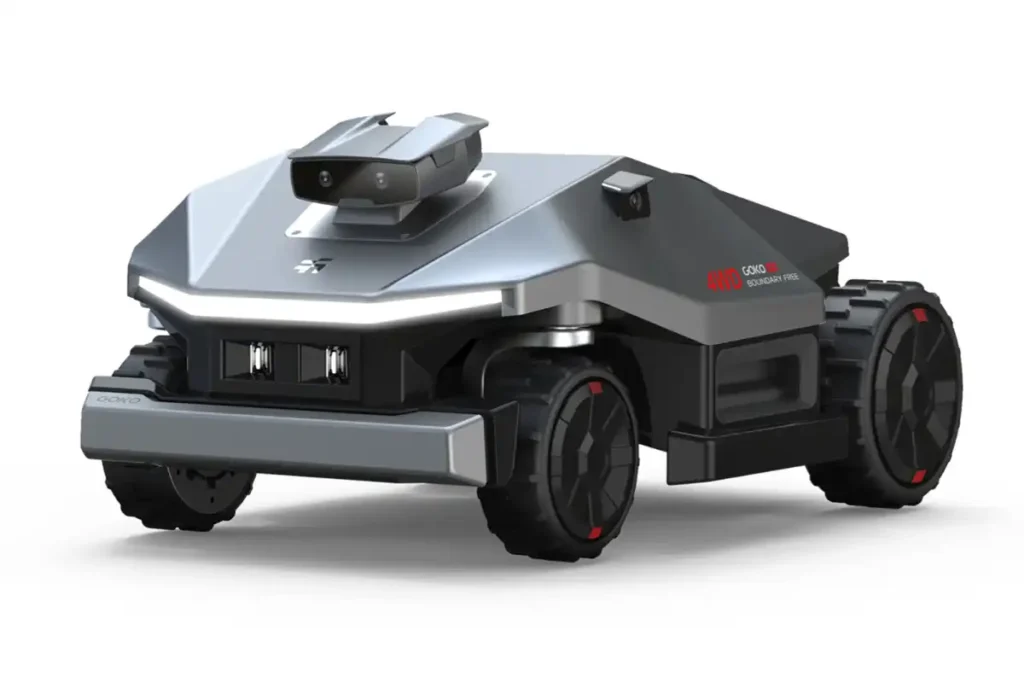
GOKO is the newest and arguably the most audacious entry on this list. The brand was unveiled at CES 2026 as the consumer-facing arm of RobotPlusPlus — a company that spent more than a decade building autonomous robots for high-risk industrial work: cleaning high-rise glass facades, maintaining ship hulls, navigating environments that would be dangerous for humans. When RobotPlusPlus looked at the consumer robot mower space and saw mowers struggling with slopes, rough terrain, and complex properties, they decided to apply their industrial engineering to the problem.
The GOKO M6 is the result. It’s a genuinely impressive piece of hardware. The 4WD drivetrain with adaptive suspension allows it to handle inclines up to 90 percent — a spec that leaves virtually every other residential robot mower well behind. It can clear obstacles up to 75mm (nearly 3 inches), meaning roots, uneven paving, and ground-level landscaping features are far less likely to bring it to a halt. For navigation, GOKO developed what it calls CyberNav Fusion — a multi-layer system combining VSLAM (visual simultaneous localization and mapping), RTK, inertial measurement units, and wheel odometry. Crucially, the system prioritizes vision-based mapping as its primary method, which means it performs better than pure RTK systems in areas with obstructed satellite signals, like under tree cover or near buildings.
Obstacle avoidance uses what GOKO calls QuadVision — a four-camera setup with AI recognition that can identify over 200 distinct object types, from pets and children to garden furniture and stray toys. The mower can map and store up to 60,000 square meters of lawn area across unlimited mowing zones, all without a single foot of buried boundary wire.
The cutting system is equally substantial. A 16.5-inch floating deck — reportedly the widest in the residential robot mower segment — runs blades at 5,000 RPM and maintains consistent contact with uneven ground. Two blade configurations are available: dual rotary mulching blades for heavy or fast-growing grass, and dual razor-disc blades for quieter, more precise daily maintenance. An expandable battery system offers up to six hours of runtime, allowing the mower to cover up to an acre in a single session or two acres in a day with scheduled charges.
The GOKO M6’s Kickstarter campaign launched in May 2026, with an estimated delivery window of August 2026. Early-bird backers can secure the unit at a significant discount from the full retail price of $2,999.
Who should consider GOKO? Anyone with a large, complicated, or sloped property who has given up on mainstream robot mowers because they simply couldn’t handle the terrain. GOKO is not an entry-level purchase — it’s for serious homeowners who want the kind of reliability and traction that industrial engineering can provide, brought into a well-designed consumer product. If you’ve watched other robot mowers fail on your hill or get confused by your complex yard layout, the M6 is built with exactly your situation in mind.
The Bottom Line
The robot mower landscape has matured rapidly, and these four brands each bring something distinct to the table. MOVA leads on LiDAR precision and ecosystem integration. ANTHBOT wins on real-world simplicity and user support. LawnSense is carving out a promising niche with the Tango, bringing a community-driven, smart-sensing approach via Kickstarter. And GOKO arrives with industrial credibility and terrain-conquering hardware that no residential mower has matched before.
No matter what your lawn looks like — small and tidy, large and lumpy, or somewhere in between — there’s now a robot mower brand worth serious consideration that probably wasn’t on your radar a year ago. At Mowing Magic, we’ll keep watching these brands closely as their products ship and real-world results roll in. As always, the best mower is the one that fits your lawn, not just the one with the most impressive spec sheet.