

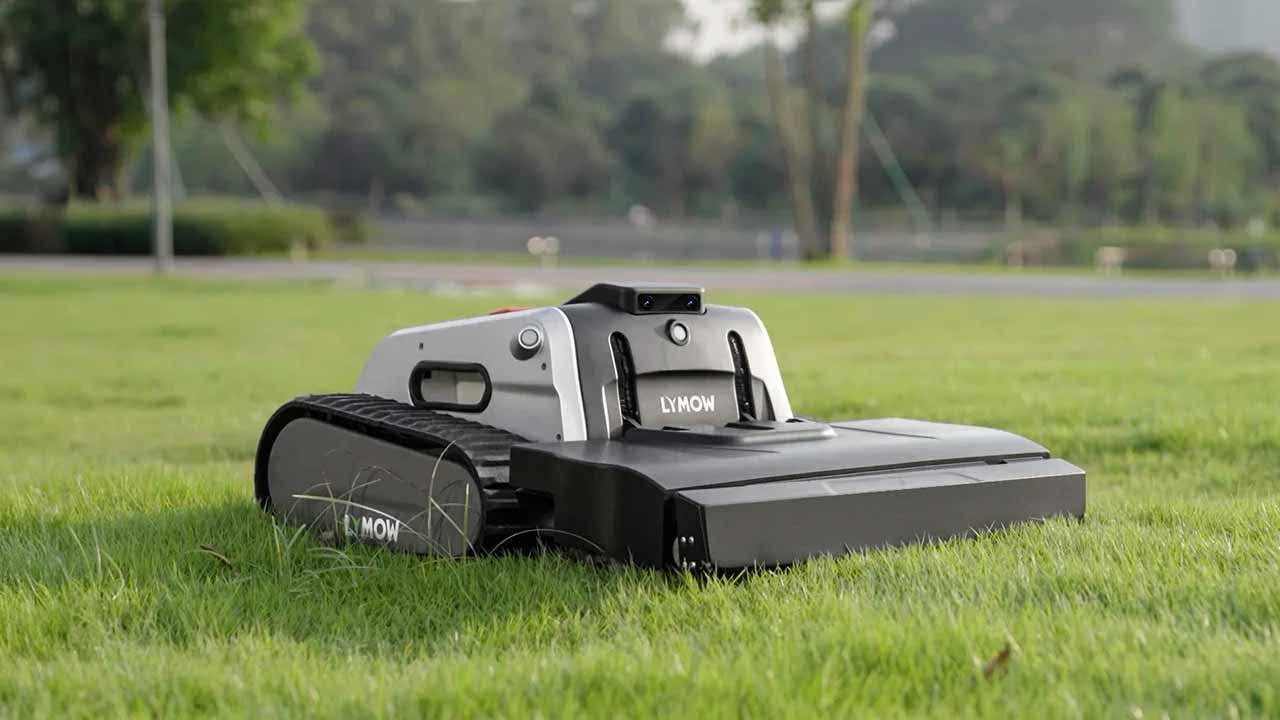
For homeowners with sloped or hilly properties, lawn maintenance has traditionally been one of the most challenging and potentially dangerous outdoor tasks. Standard robot mowers often struggle or fail completely on inclines, leaving property owners to manually push heavy mowers up and down hills or hire expensive landscaping services. However, recent innovations in robotic lawn care technology have introduced all-wheel drive systems and advanced traction solutions that are revolutionizing how we approach lawn maintenance on challenging terrain.
Understanding the Challenge of Steep Lawns
Before diving into the solutions, it’s important to understand why slope presents such a significant challenge for robotic mowers. Traditional robot mowers typically use a two-wheel drive system, where only the rear wheels provide propulsion while the front wheels simply follow along. On flat or gently sloping terrain, this works perfectly well. But when the incline increases beyond 15-20 degrees, several problems emerge.
First, there’s the issue of traction. As the slope increases, the mower’s weight distribution shifts, reducing the contact pressure on the drive wheels. This can cause the wheels to slip, leaving the mower stuck or unable to maintain its intended path. Second, there’s the risk of the mower sliding sideways or even tumbling, which can damage the unit and create safety hazards. Finally, many robot mowers use their wheel rotation to navigate and map the lawn—when wheels slip on slopes, this navigation becomes unreliable.
For properties with slopes exceeding 20 degrees (roughly 36% grade), standard robot mowers simply aren’t designed to handle the job safely or effectively. This is where all-wheel drive technology and alternative traction systems become game-changers.
The All-Wheel Drive Advantage
All-wheel drive (AWD) robot mowers address the traction problem by powering all wheels simultaneously. Instead of relying solely on the rear wheels for propulsion, AWD systems distribute power to every wheel, dramatically increasing the amount of rubber in contact with the ground that’s actively gripping and pushing.
This technology provides several key benefits for sloped terrain. The increased traction means the mower can maintain consistent contact with the ground even when climbing steep inclines. The balanced power distribution helps prevent the mower from sliding sideways, a common problem with two-wheel drive systems on slopes. Additionally, AWD systems provide more predictable and reliable navigation, as all wheels maintain their grip and the mower can better follow its programmed path.
When shopping for an AWD robot mower for steep terrain, look for models rated for slopes of at least 50-60% grade (approximately 27-31 degrees). These ratings indicate that the manufacturer has tested and verified the mower’s ability to handle serious inclines safely and effectively.
Top All-Wheel Drive Models for Steep Terrain
Several manufacturers have developed impressive AWD robot mowers specifically designed to handle challenging slopes. The Husqvarna EPOS series represents some of the most advanced AWD technology on the market, with certain models rated for slopes up to 70% (35 degrees). These mowers use satellite navigation combined with RTK GPS for precise positioning, ensuring they maintain their course even on steep inclines. The AWD system works in conjunction with their intelligent drive system to optimize traction and prevent slippage.
The WORX Landroid Vision series includes AWD models that leverage computer vision and AI to navigate complex terrain. While primarily designed for obstacle avoidance, this technology also helps the mower optimize its path up and down slopes, choosing routes that maximize traction and minimize stress on the drive system. These models typically handle slopes up to 50-60%, making them suitable for most residential properties with challenging topography.
Segway’s Navimow line has also entered the steep-terrain market with its X4 AWD model that use GPS-based navigation. The X4 is their most advanced four-wheel drive with dual suspensions for all-terrain control, crossing obstacles up to 2.8 inches and climbing slopes up to 84%(40°) with confident stability.
For properties with less extreme slopes but still beyond the capability of standard mowers, the Mammotion LUBA series offers AWD models with RTK GPS navigation that can handle grades up to 75% (approximately 37 degrees). These mowers are particularly notable for their large cutting widths, which can reduce mowing time on sloped properties where efficiency is especially valuable.
Beyond Wheels: Track-Based Systems
While all-wheel drive represents a significant improvement over traditional two-wheel drive systems, some manufacturers have taken an entirely different approach to the traction problem by abandoning wheels altogether in favor of continuous tracks—similar to those found on tanks and bulldozers. This design philosophy has produced some of the most capable slope-handling robot mowers available today.
Lymow: Tank-Like Traction for Extreme Terrain
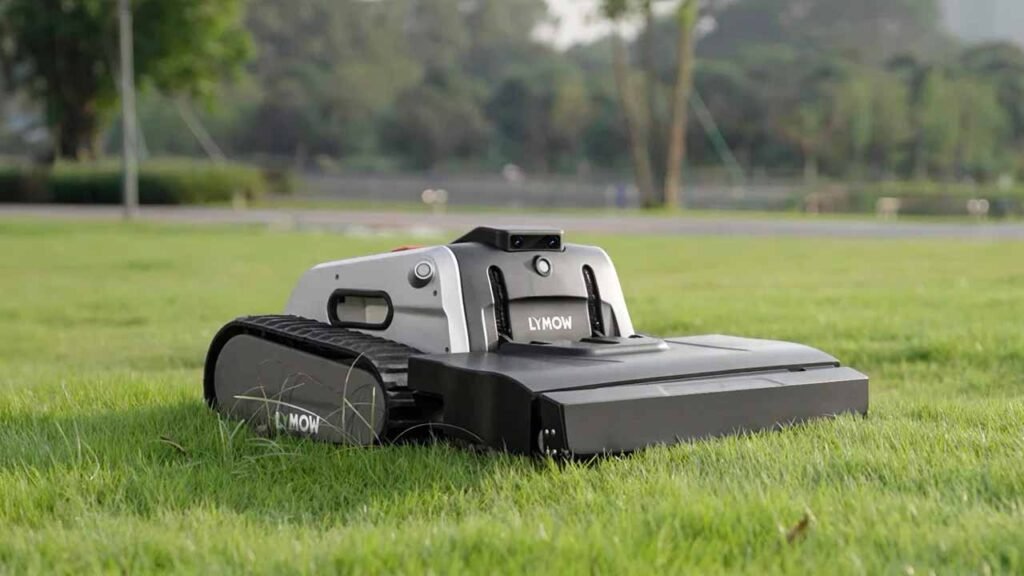
Lymow has developed robot mowers that use rubber tracks instead of wheels, providing a dramatically larger contact patch with the ground. This design distributes the mower’s weight over a much larger area, significantly reducing ground pressure while simultaneously increasing traction. The result is a robot mower that can handle slopes that would stop an AWD wheeled mower in its tracks—literally.
Lymow’s track-based mowers are rated for slopes up to an impressive 100% grade (45 degrees), making them suitable for properties that would otherwise be impossible to mow with robotic equipment. The tracks provide superior grip on wet grass, loose soil, and uneven terrain—conditions that often cause wheeled mowers to slip and slide. Additionally, the track system offers better stability, reducing the risk of the mower tipping over on steep cross-slopes.
The wider footprint provided by tracks also means Lymow mowers are less likely to leave ruts or damage the lawn on slopes, as the weight is distributed more evenly. This is particularly important on hills where repeated passes by a heavy mower can gradually erode the soil if pressure points are too concentrated.
Yarbo: Multi-Functional Tracked Power Platform
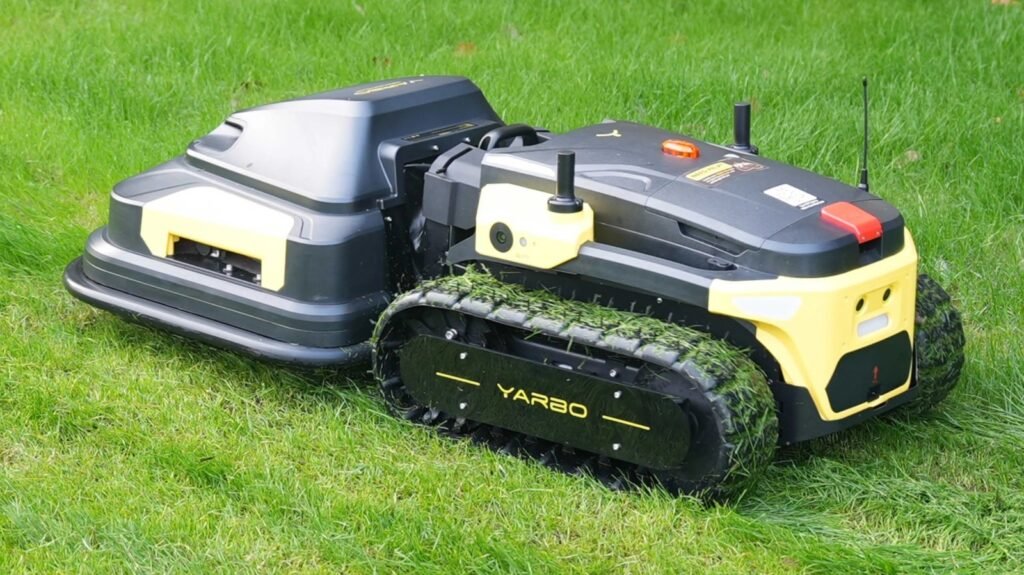
Yarbo takes the tracked approach even further by creating an entire modular outdoor power platform. The Yarbo system uses a powerful tracked base unit that can be fitted with different attachments for various yard tasks—including a lawn mowing module designed specifically for challenging terrain.
What makes Yarbo particularly impressive for steep properties is its incredibly robust track system and powerful motors. The base unit is engineered to handle slopes up to 68% grade (approximately 34 degrees) while carrying various attachments, demonstrating exceptional stability and power. The tracks are wider and more aggressive than those found on typical tracked mowers, providing extraordinary traction on steep, wet, or loose surfaces.
Beyond just mowing, Yarbo’s modular design means the same tracked base that mows your steep lawn in summer can be fitted with a snow blowing attachment for winter, making it a year-round solution for properties with challenging topography. This versatility can justify the higher initial investment for property owners who need robust equipment capable of handling multiple tasks on sloped terrain.
The Yarbo system also incorporates advanced AI navigation and obstacle avoidance, using cameras and sensors to map the property and navigate safely. This is particularly valuable on steep properties where obstacles like trees, rocks, and landscape features can create additional navigation challenges beyond the slope itself.
The Remote Control Option: Mowrator
For those who want the power and capability of advanced slope-mowing technology but prefer to maintain direct control over their equipment, the Mowrator offers an intriguing alternative to fully autonomous systems. Rather than operating independently like traditional robot mowers, the Mowrator is a remote-controlled mower that combines the safety benefits of distance operation with the precision of human judgment.
The Mowrator is specifically engineered for extreme terrain and can handle slopes up to 60 degrees (approximately 173% grade), making it one of the most capable slope mowers available regardless of category. This exceptional performance comes from its rugged construction, powerful motors, and operator-controlled navigation that allows real-time adjustments to changing terrain conditions.
What makes the Mowrator particularly valuable for challenging properties is the ability to keep the operator safe while tackling dangerous slopes. Instead of physically walking behind a mower on a steep, potentially slippery hillside—a situation that leads to thousands of injuries annually—the operator can control the Mowrator from a safe, level position using a remote control. This dramatically reduces the risk of slips, falls, and other slope-related accidents while still maintaining the control and decision-making that comes with manual operation.
The remote-controlled approach also offers advantages in situations where fully autonomous mowers might struggle with decision-making. On properties with complex obstacles, varying vegetation density, or frequently changing conditions, having a human operator making real-time decisions can result in more efficient and effective mowing. The Mowrator essentially provides the muscle and traction of advanced robotic systems while keeping human intelligence in the control loop.
Making the Choice: Autonomous vs. Remote-Controlled vs. Tracked
When deciding between all-wheel drive wheeled mowers, track-based systems, and remote-controlled options, several factors come into play beyond just slope capability.
Fully autonomous wheeled AWD mowers generally offer faster mowing speeds on flatter sections of the lawn and may be more energy-efficient on mixed terrain. They provide the ultimate in convenience—set them up once, and they’ll handle the mowing schedule without any further input. They’re ideal for property owners who want a true “set it and forget it” solution and whose slopes fall within the 50-70% range that quality AWD systems can handle.
Track-based systems like Lymow and Yarbo excel in extreme conditions and provide superior autonomous performance on very steep terrain. If your property has slopes exceeding 60-70%, or if you deal with frequently wet or muddy conditions, tracks provide the best autonomous performance. The trade-offs are typically higher initial cost, potentially slower mowing speeds, and increased weight.
Remote-controlled systems like the Mowrator offer a middle ground that combines advanced traction capabilities with human control. They’re particularly well-suited for properties with extremely steep slopes, highly irregular terrain, or situations where obstacles and conditions change frequently. The operator maintains full control over the mowing pattern, speed, and navigation, which can be valuable for properties that don’t lend themselves well to automated mapping and path planning. However, they do require the operator’s time and attention during each mowing session, eliminating the hands-free convenience of truly autonomous systems.
Consider your specific needs carefully. If you have consistent terrain that you want mowed automatically on a schedule, autonomous systems (either wheeled or tracked) make the most sense. If you have extreme slopes, highly variable conditions, or simply prefer to maintain control over the process while avoiding the physical danger of manual mowing on steep terrain, a remote-controlled system like the Mowrator might be the better choice.
Installation and Safety Considerations
Regardless of which technology you choose, proper installation and setup are crucial for safe operation on steep terrain. Most advanced robot mowers now use GPS-based navigation systems, which eliminate the need for boundary wires—a significant advantage on slopes where installing wires can be challenging and where the wires themselves might be damaged by erosion or shifting soil.
Work with a professional installer experienced with steep-terrain installations, or carefully follow the manufacturer’s guidelines if installing yourself. Most autonomous systems require a learning period where they map the property, and it’s important to supervise this process on slopes to ensure the mower is identifying and handling the terrain correctly.
For remote-controlled systems like the Mowrator, take time to practice on less challenging terrain before tackling the steepest slopes. Familiarize yourself with the controls, understand how the machine responds to inputs, and develop a feel for its capabilities and limitations.
Consider installing multiple charging stations if your property has both high and low areas and you’re using an autonomous system. This can help ensure the mower doesn’t run out of power halfway through climbing a steep section, which could leave it stranded in a difficult-to-access location.
Conclusion
The evolution of all-wheel drive robot mowers, tracked systems like Lymow and Yarbo, and remote-controlled options like the Mowrator has opened up modern lawn care solutions to property owners who previously had no choice but to manually tackle their steep terrain or hire landscaping services. Whether you choose the convenience of autonomous AWD wheels, the extreme capability of continuous tracks, or the controlled power of remote operation, modern technology has made it possible to safely maintain lawns on even the most challenging slopes.
By carefully assessing your property’s specific characteristics, your personal preferences for automation versus control, and your budget, you can find the perfect solution to keep your sloped property looking immaculate without risking your safety or spending hours each week on dangerous manual labor.